Microsoft Dinosaurs
Triceratops
Triceratops
Triceratops

try-SAIR-uh-tops name means β€œThree-horned face”

Three horns, a massive neck shield, and the bulk of a truck β€” Triceratops was built for battle!

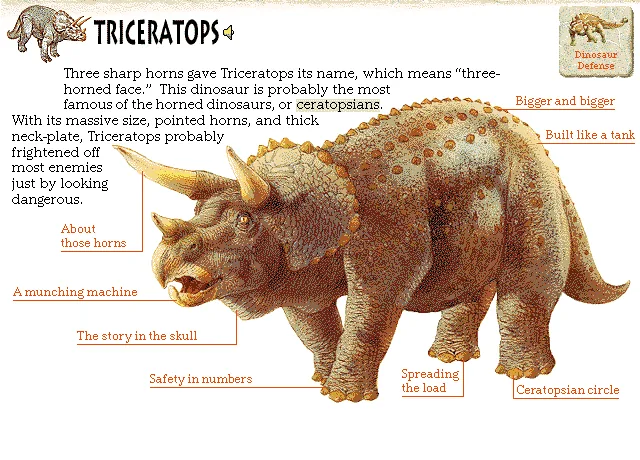
Three sharp horns gave Triceratops its name, which means "three-horned face." This dinosaur is probably the most famous of the horned dinosaurs, or ceratopsians. With its massive size, pointed horns, and thick neck-plate, Triceratops probably frightened off most enemies just by looking dangerous.

Explore

About Those Horns

About Those Horns

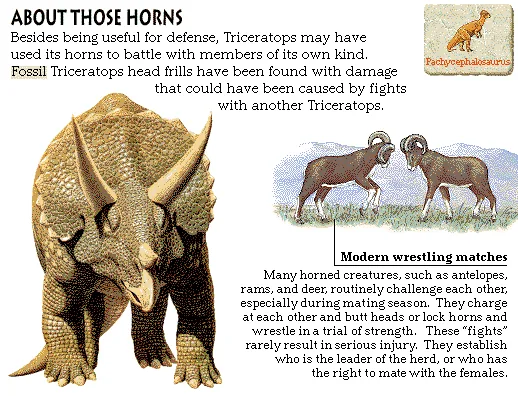
Besides being useful for defense, Triceratops may have used its horns to battle with members of its own kind. Fossil Triceratops head frills have been found with damage that could have been caused by fights with another Triceratops.

Modern wrestling matchesMany horned creatures, such as antelopes, rams, and deer, routinely challenge each other, especially during mating season. They charge at each other and butt heads or lock horns and wrestle in a trial of strength. These "fights" rarely result in serious injury. They establish who is the leader of the herd, or who has the right to mate with the females.
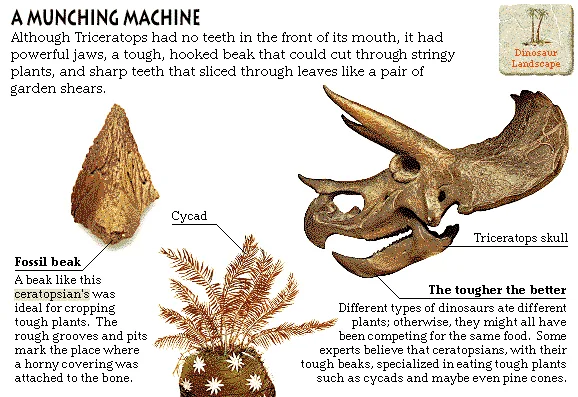
A Munching Machine

A Munching Machine

Although Triceratops had no teeth in the front of its mouth, it had powerful jaws, a tough, hooked beak that could cut through stringy plants, and sharp teeth that sliced through leaves like a pair of garden shears.

Fossil beakA beak like this ceratopsian's was ideal for cropping tough plants. The rough grooves and pits mark the place where a horny covering was attached to the bone.
The tougher the betterDifferent types of dinosaurs ate different plants; otherwise, they might all have been competing for the same food. Some experts believe that ceratopsians, with their tough beaks, specialized in eating tough plants such as cycads and maybe even pine cones.
The Story in the Skull

The Story in the Skull

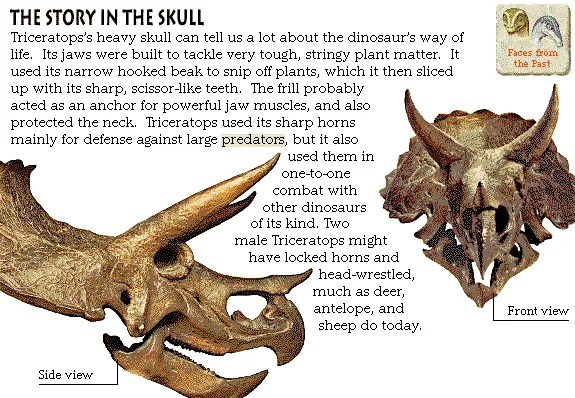
Triceratops's heavy skull can tell us a lot about the dinosaur's way of life. Its jaws were built to tackle very tough, stringy plant matter. It used its narrow hooked beak to snip off plants, which it then sliced up with its sharp, scissor-like teeth. The frill probably acted as an anchor for powerful jaw muscles, and also protected the neck. Triceratops used its sharp horns mainly for defense against large predators, but it also used them in one-to-one combat with other dinosaurs of its kind. Two male Triceratops might have locked horns and head-wrestled, much as deer, antelope, and sheep do today.

Built Like a Tank

Built Like a Tank

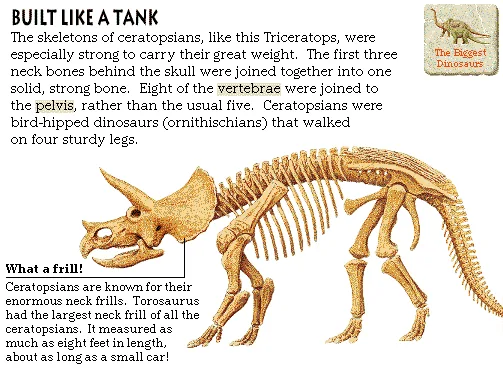
The skeletons of ceratopsians, like this Triceratops, were especially strong to carry their great weight. The first three neck bones behind the skull were joined together into one solid, strong bone. Eight of the vertebrae were joined to the pelvis, rather than the usual five. Ceratopsians were bird-hipped dinosaurs (ornithischians) that walked on four sturdy legs.

What a frill!Ceratopsians are known for their enormous neck frills. Torosaurus had the largest neck frill of all the ceratopsians. It measured as much as eight feet in length, about as long as a small car!
Bigger and Bigger

Bigger and Bigger

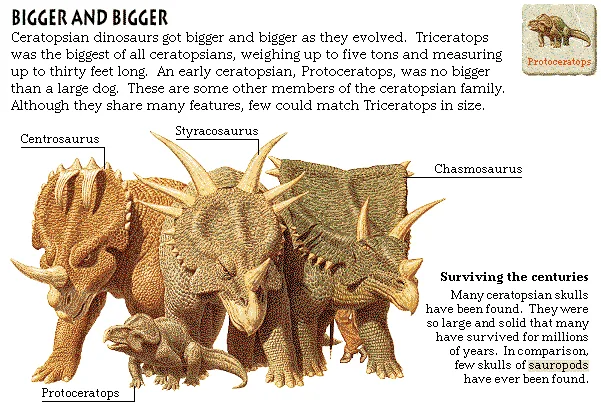
Ceratopsian dinosaurs got bigger and bigger as they evolved. Triceratops was the biggest of all ceratopsians, weighing up to five tons and measuring up to thirty feet long. An early ceratopsian, Protoceratops, was no bigger than a large dog. These are some other members of the ceratopsian family. Although they share many features, few could match Triceratops in size.

Surviving the centuriesMany ceratopsian skulls have been found. They were so large and solid that many have survived for millions of years. In comparison, few skulls of sauropods have ever been found.
Ceratopsian Circle

Ceratopsian Circle

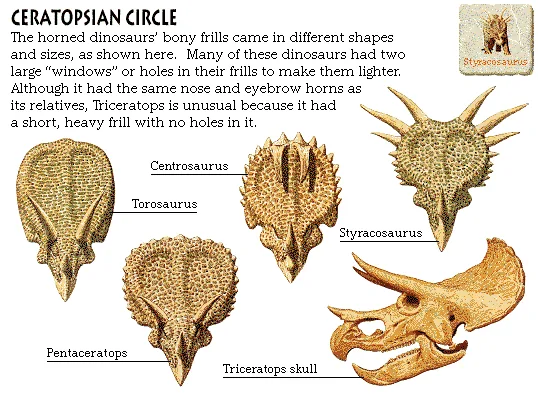
The horned dinosaurs' bony frills came in different shapes and sizes, as shown here. Many of these dinosaurs had two large "windows" or holes in their frills to make them lighter. Although it had the same nose and eyebrow horns as its relatives, Triceratops is unusual because it had a short, heavy frill with no holes in it.

Safety in Numbers

Safety in Numbers

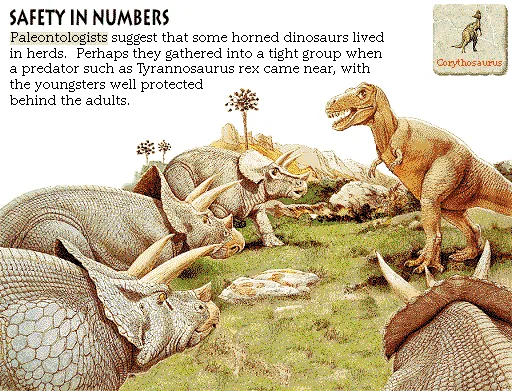
Paleontologists suggest that some horned dinosaurs lived in herds. Perhaps they gathered into a tight group when a predator such as Tyrannosaurus rex came near, with the youngsters well protected behind the adults.

Spreading the Load

Spreading the Load

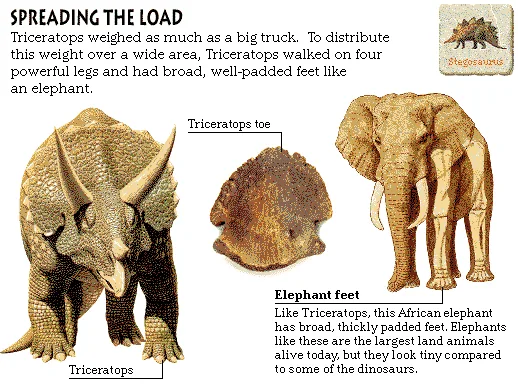
Triceratops weighed as much as a big truck. To distribute this weight over a wide area, Triceratops walked on four powerful legs and had broad, well-padded feet like an elephant.

Elephant feetLike Triceratops, this African elephant has broad, thickly padded feet. Elephants like these are the largest land animals alive today, but they look tiny compared to some of the dinosaurs.

Explore more

Source: Microsoft Dinosaurs (1993) CD-ROM. Text liberated from original screen art; images & audio restored from disc. Original media is Microsoft/supplier copyright β€” non-commercial educational preservation. Credits & Acknowledgements