Microsoft Dinosaurs
Corythosaurus
Corythosaurus
Corythosaurus

koh-RITH-oh-SOR-us name means β€œHelmet lizard”

The helmet-headed hadrosaur that may have blasted its calls through a hollow bony crest!

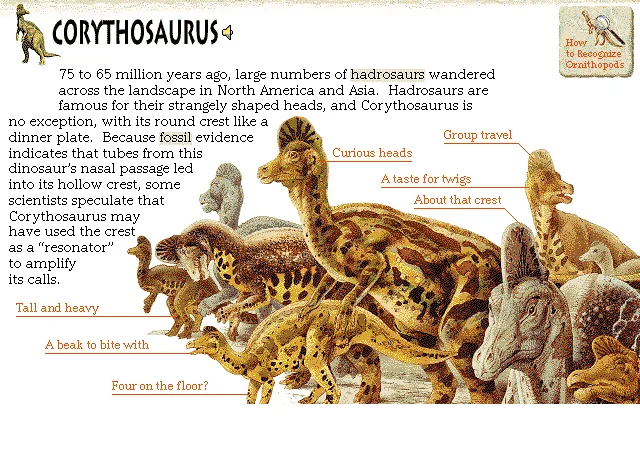
75 to 65 million years ago, large numbers of hadrosaurs wandered across the landscape in North America and Asia. Hadrosaurs are famous for their strangely shaped heads, and Corythosaurus is no exception, with its round crest like a dinner plate. Because fossil evidence indicates that tubes from this dinosaur's nasal passage led into its hollow crest, some scientists speculate that Corythosaurus may have used the crest as a "resonator" to amplify its calls.

Explore

Curious Heads

Curious Heads

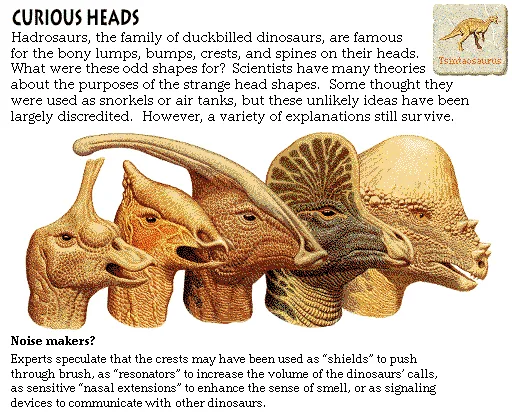
Hadrosaurs, the family of duckbilled dinosaurs, are famous for the bony lumps, bumps, crests, and spines on their heads. What were these odd shapes for? Scientists have many theories about the purposes of the strange head shapes. Some thought they were used as snorkels or air tanks, but these unlikely ideas have been largely discredited. However, a variety of explanations still survive.

Noise makers?Experts speculate that the crests may have been used as "shields" to push through brush, as "resonators" to increase the volume of the dinosaurs' calls, as sensitive "nasal extensions" to enhance the sense of smell, or as signaling devices to communicate with other dinosaurs.
Group Travel

Group Travel

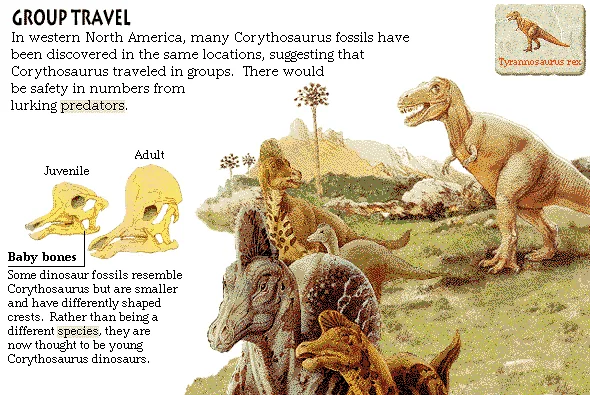
In western North America, many Corythosaurus fossils have been discovered in the same locations, suggesting that Corythosaurus traveled in groups. There would be safety in numbers from lurking predators.

Baby bonesSome dinosaur fossils resemble Corythosaurus but are smaller and have differently shaped crests. Rather than being a different species, they are now thought to be young Corythosaurus dinosaurs.
A Beak to Bite With

A Beak to Bite With

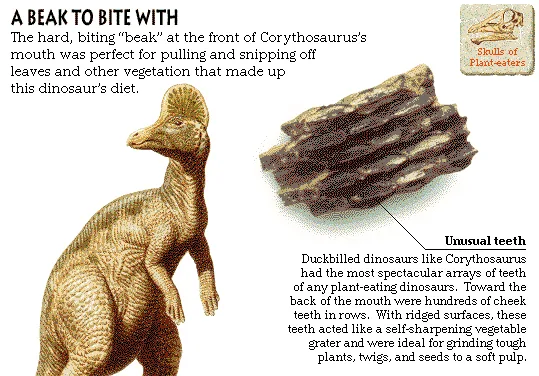
The hard, biting "beak" at the front of Corythosaurus's mouth was perfect for pulling and snipping off leaves and other vegetation that made up this dinosaur's diet.

Unusual teethDuckbilled dinosaurs like Corythosaurus had the most spectacular arrays of teeth of any plant-eating dinosaurs. Toward the back of the mouth were hundreds of cheek teeth in rows. With ridged surfaces, these teeth acted like a self-sharpening vegetable grater and were ideal for grinding tough plants, twigs, and seeds to a soft pulp.
Four on the Floor?

Four on the Floor?

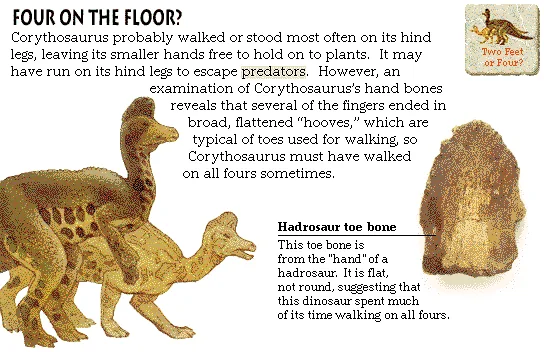
Corythosaurus probably walked or stood most often on its hind legs, leaving its smaller hands free to hold on to plants. It may have run on its hind legs to escape predators. However, an examination of Corythosaurus's hand bones reveals that several of the fingers ended in broad, flattened "hooves," which are typical of toes used for walking, so Corythosaurus must have walked on all fours sometimes.

Hadrosaur toe boneThis toe bone is from the "hand" of a hadrosaur. It is flat, not round, suggesting that this dinosaur spent much of its time walking on all fours.
A Taste for Twigs

A Taste for Twigs

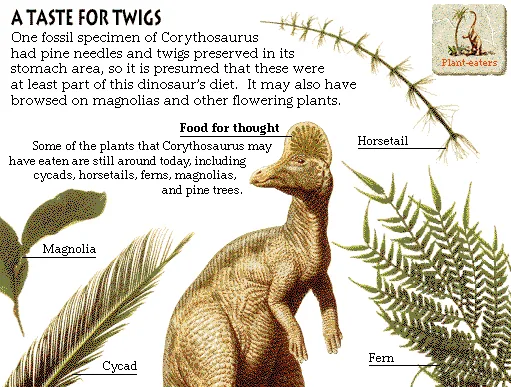
One fossil specimen of Corythosaurus had pine needles and twigs preserved in its stomach area, so it is presumed that these were at least part of this dinosaur's diet. It may also have browsed on magnolias and other flowering plants.

Food for thoughtSome of the plants that Corythosaurus may have eaten are still around today, including cycads, horsetails, ferns, magnolias, and pine trees.
About That Crest

About That Crest

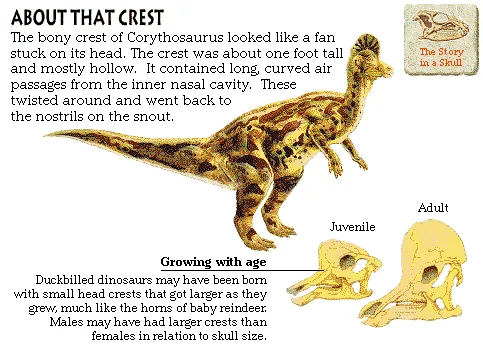
The bony crest of Corythosaurus looked like a fan stuck on its head. The crest was about one foot tall and mostly hollow. It contained long, curved air passages from the inner nasal cavity. These twisted around and went back to the nostrils on the snout.

Growing with ageDuckbilled dinosaurs may have been born with small head crests that got larger as they grew, much like the horns of baby reindeer. Males may have had larger crests than females in relation to skull size.
Tall and Heavy

Tall and Heavy

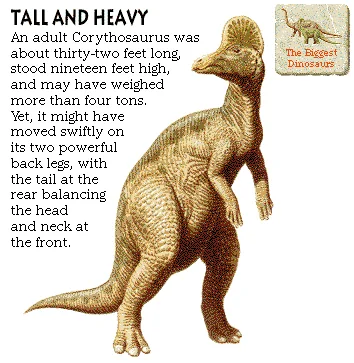
An adult Corythosaurus was about thirty-two feet long, stood nineteen feet high, and may have weighed more than four tons. Yet, it might have moved swiftly on its two powerful back legs, with the tail at the rear balancing the head and neck at the front.

Explore more

Source: Microsoft Dinosaurs (1993) CD-ROM. Text liberated from original screen art; images & audio restored from disc. Original media is Microsoft/supplier copyright β€” non-commercial educational preservation. Credits & Acknowledgements