Nest-Building Dinosaurs
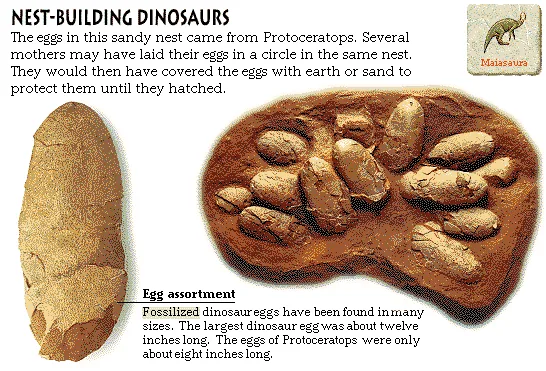
The eggs in this sandy nest came from Protoceratops. Several mothers may have laid their eggs in a circle in the same nest. They would then have covered the eggs with earth or sand to protect them until they hatched.
The first horned face — a pint-sized dinosaur that hatched in family nests and proved that dinosaurs laid eggs.
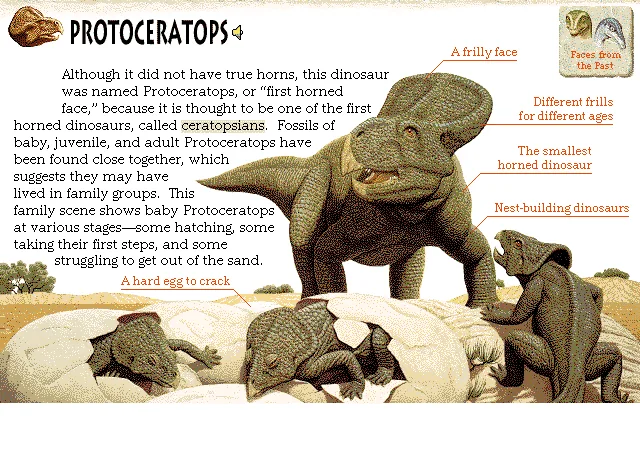
Although it did not have true horns, this dinosaur was named Protoceratops, or "first horned face," because it is thought to be one of the first horned dinosaurs, called ceratopsians. Fossils of baby, juvenile, and adult Protoceratops have been found close together, which suggests they may have lived in family groups. This family scene shows baby Protoceratops at various stages—some hatching, some taking their first steps, and some struggling to get out of the sand.

The eggs in this sandy nest came from Protoceratops. Several mothers may have laid their eggs in a circle in the same nest. They would then have covered the eggs with earth or sand to protect them until they hatched.

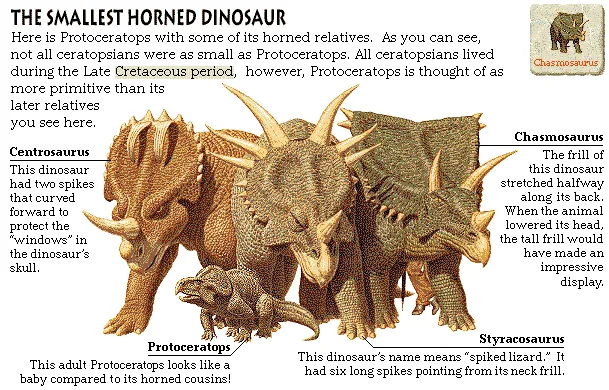
Here is Protoceratops with some of its horned relatives. As you can see, not all ceratopsians were as small as Protoceratops. All ceratopsians lived during the Late Cretaceous period, however, Protoceratops is thought of as more primitive than its later relatives you see here.

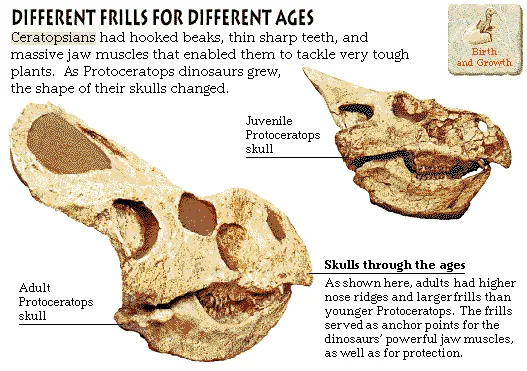
Ceratopsians had hooked beaks, thin sharp teeth, and massive jaw muscles that enabled them to tackle very tough plants. As Protoceratops dinosaurs grew, the shape of their skulls changed.

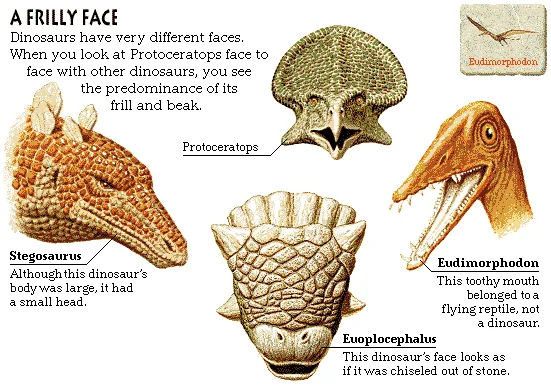
Dinosaurs have very different faces. When you look at Protoceratops face to face with other dinosaurs, you see the predominance of its frill and beak.

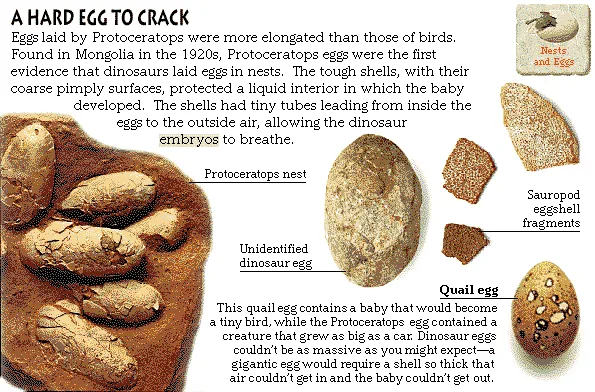
Eggs laid by Protoceratops were more elongated than those of birds. Found in Mongolia in the 1920s, Protoceratops eggs were the first evidence that dinosaurs laid eggs in nests. The tough shells, with their coarse pimply surfaces, protected a liquid interior in which the baby developed. The shells had tiny tubes leading from inside the eggs to the outside air, allowing the dinosaur embryos to breathe.
Source: Microsoft Dinosaurs (1993) CD-ROM. Text liberated from original screen art; images & audio restored from disc. Original media is Microsoft/supplier copyright — non-commercial educational preservation. Credits & Acknowledgements