Airheads
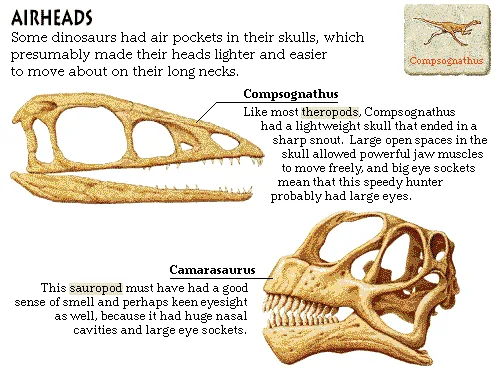
Some dinosaurs had air pockets in their skulls, which presumably made their heads lighter and easier to move about on their long necks.
A dinosaur's skull is a treasure map — read it right and it tells you how the animal lived, what it ate, and how smart it was.
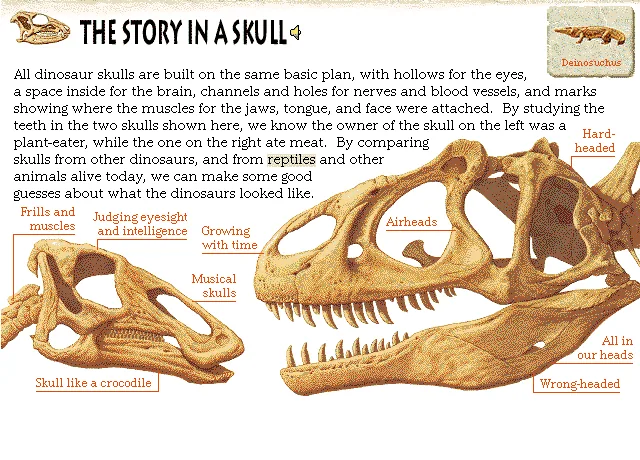
All dinosaur skulls are built on the same basic plan, with hollows for the eyes, a space inside for the brain, channels and holes for nerves and blood vessels, and marks showing where the muscles for the jaws, tongue, and face were attached. By studying the teeth in the two skulls shown here, we know the owner of the skull on the left was a plant-eater, while the one on the right ate meat. By comparing skulls from other dinosaurs, and from reptiles and other animals alive today, we can make some good guesses about what the dinosaurs looked like.

Some dinosaurs had air pockets in their skulls, which presumably made their heads lighter and easier to move about on their long necks.

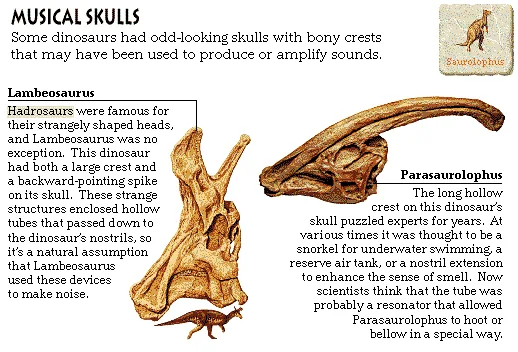
Some dinosaurs had odd-looking skulls with bony crests that may have been used to produce or amplify sounds.

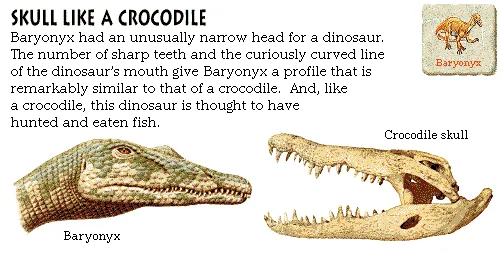
Baryonyx had an unusually narrow head for a dinosaur. The number of sharp teeth and the curiously curved line of the dinosaur's mouth give Baryonyx a profile that is remarkably similar to that of a crocodile. And, like a crocodile, this dinosaur is thought to have hunted and eaten fish.

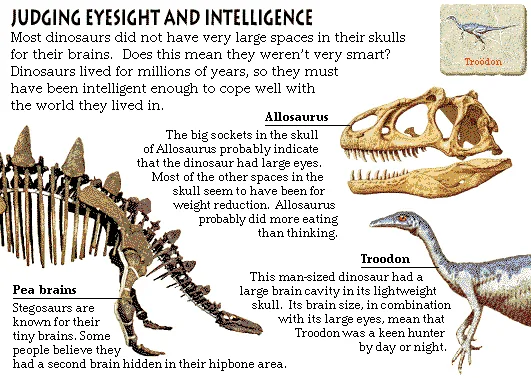
Most dinosaurs did not have very large spaces in their skulls for their brains. Does this mean they weren't very smart? Dinosaurs lived for millions of years, so they must have been intelligent enough to cope well with the world they lived in.

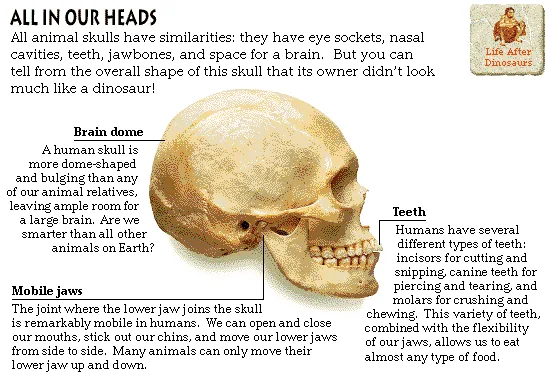
All animal skulls have similarities: they have eye sockets, nasal cavities, teeth, jawbones, and space for a brain. But you can tell from the overall shape of this skull that its owner didn't look much like a dinosaur!

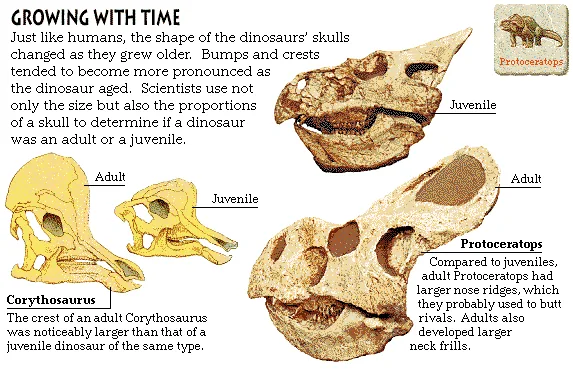
Just like humans, the shape of the dinosaurs' skulls changed as they grew older. Bumps and crests tended to become more pronounced as the dinosaur aged. Scientists use not only the size but also the proportions of a skull to determine if a dinosaur was an adult or a juvenile.

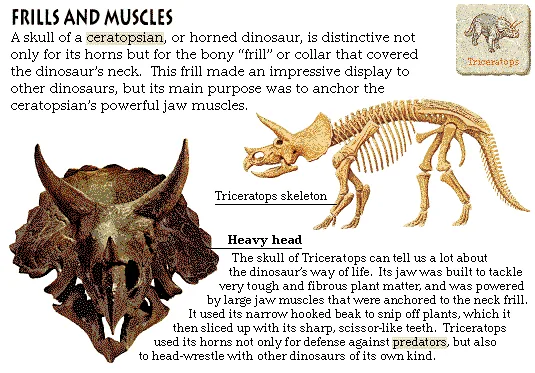
A skull of a ceratopsian, or horned dinosaur, is distinctive not only for its horns but for the bony "frill" or collar that covered the dinosaur's neck. This frill made an impressive display to other dinosaurs, but its main purpose was to anchor the ceratopsian's powerful jaw muscles.

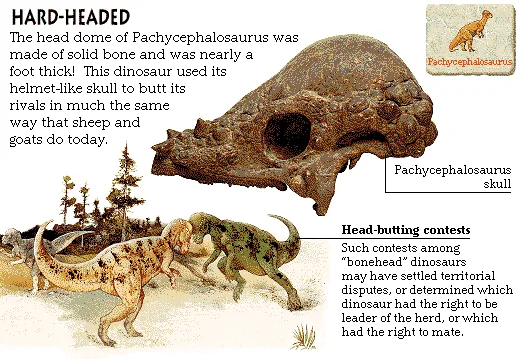
The head dome of Pachycephalosaurus was made of solid bone and was nearly a foot thick! This dinosaur used its helmet-like skull to butt its rivals in much the same way that sheep and goats do today.

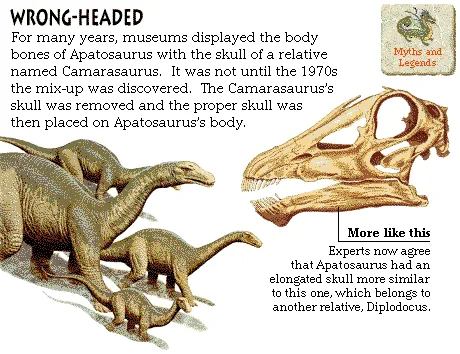
For many years, museums displayed the body bones of Apatosaurus with the skull of a relative named Camarasaurus. It was not until the 1970s the mix-up was discovered. The Camarasaurus's skull was removed and the proper skull was then placed on Apatosaurus's body.
Source: Microsoft Dinosaurs (1993) CD-ROM. Text liberated from original screen art; images & audio restored from disc. Original media is Microsoft/supplier copyright — non-commercial educational preservation. Credits & Acknowledgements