Microsoft Dinosaurs
Iguanodon
Iguanodon
Iguanodon

ih-GWAHN-oh-don name means β€œiguana tooth”

The very first dinosaur ever identified β€” complete with a secret-weapon thumb spike!

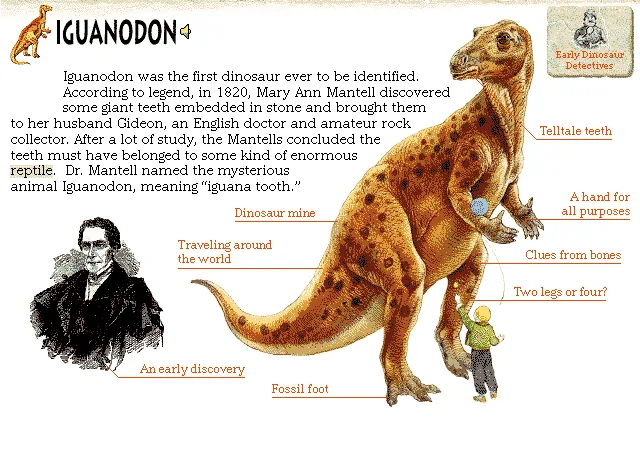
Iguanodon was the first dinosaur ever to be identified. According to legend, in 1820, Mary Ann Mantell discovered some giant teeth embedded in stone and brought them to her husband Gideon, an English doctor and amateur rock collector. After a lot of study, the Mantells concluded the teeth must have belonged to some kind of enormous reptile. Dr. Mantell named the mysterious animal Iguanodon, meaning "iguana tooth."

Explore

Traveling Around the World

Traveling Around the World

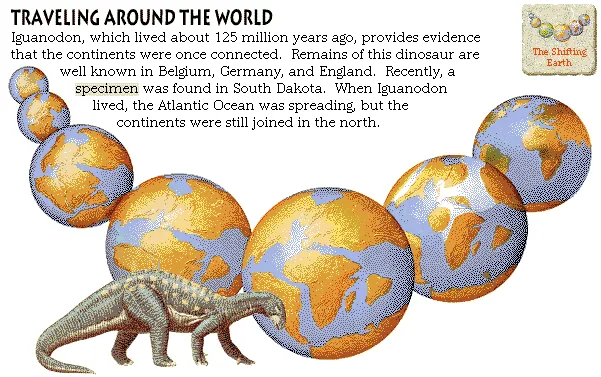
Iguanodon, which lived about 125 million years ago, provides evidence that the continents were once connected. Remains of this dinosaur are well known in Belgium, Germany, and England. Recently, a specimen was found in South Dakota. When Iguanodon lived, the Atlantic Ocean was spreading, but the continents were still joined in the north.
Two Legs or Four?

Two Legs or Four?

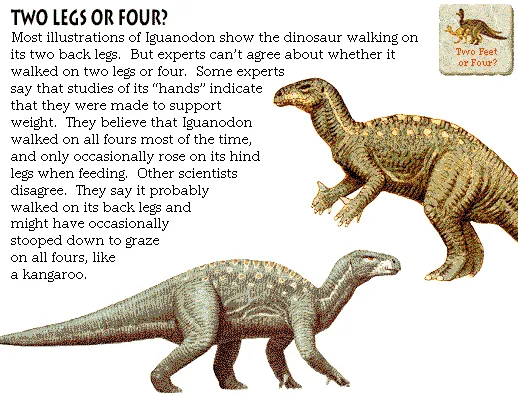
Most illustrations of Iguanodon show the dinosaur walking on its two back legs. But experts can't agree about whether it walked on two legs or four. Some experts say that studies of its "hands" indicate that they were made to support weight. They believe that Iguanodon walked on all fours most of the time, and only occasionally rose on its hind legs when feeding. Other scientists disagree. They say it probably walked on its back legs and might have occasionally stooped down to graze on all fours, like a kangaroo.

A Hand for All Purposes

A Hand for All Purposes

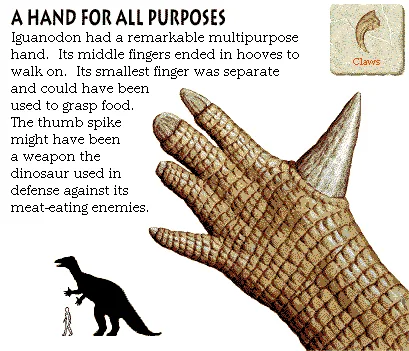
Iguanodon had a remarkable multipurpose hand. Its middle fingers ended in hooves to walk on. Its smallest finger was separate and could have been used to grasp food. The thumb spike might have been a weapon the dinosaur used in defense against its meat-eating enemies.

Clues from Bones

Clues from Bones

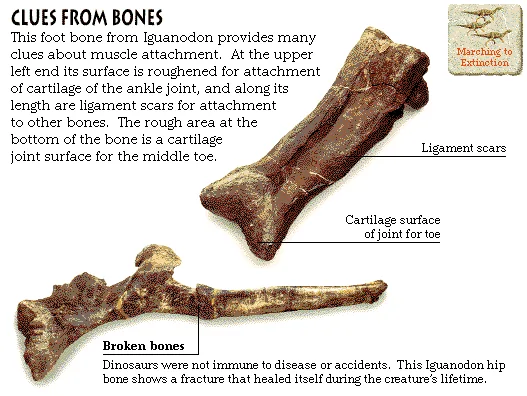
This foot bone from Iguanodon provides many clues about muscle attachment. At the upper left end its surface is roughened for attachment of cartilage of the ankle joint, and along its length are ligament scars for attachment to other bones. The rough area at the bottom of the bone is a cartilage joint surface for the middle toe.

Broken bonesDinosaurs were not immune to disease or accidents. This Iguanodon hip bone shows a fracture that healed itself during the creature's lifetime.
Fossil Foot

Fossil Foot

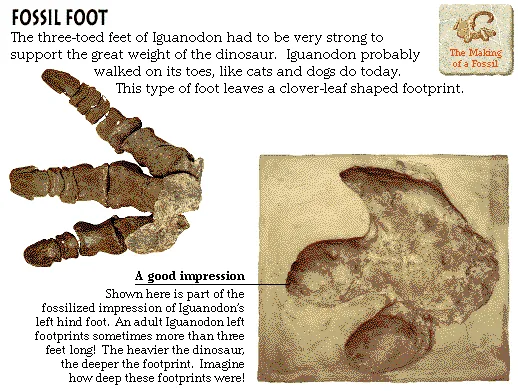
The three-toed feet of Iguanodon had to be very strong to support the great weight of the dinosaur. Iguanodon probably walked on its toes, like cats and dogs do today. This type of foot leaves a clover-leaf shaped footprint.

A good impressionShown here is part of the fossilized impression of Iguanodon's left hind foot. An adult Iguanodon left footprints sometimes more than three feet long! The heavier the dinosaur, the deeper the footprint. Imagine how deep these footprints were!
Dinosaur Mine

Dinosaur Mine

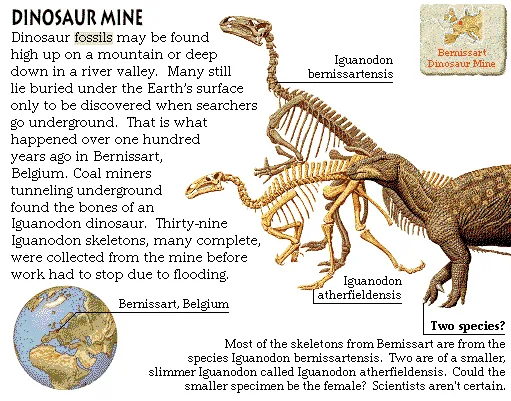
Dinosaur fossils may be found high up on a mountain or deep down in a river valley. Many still lie buried under the Earth's surface only to be discovered when searchers go underground. That is what happened over one hundred years ago in Bernissart, Belgium. Coal miners tunneling underground found the bones of an Iguanodon dinosaur. Thirty-nine Iguanodon skeletons, many complete, were collected from the mine before work had to stop due to flooding.

Two species?Most of the skeletons from Bernissart are from the species Iguanodon bernissartensis. Two are of a smaller, slimmer Iguanodon called Iguanodon atherfieldensis. Could the smaller specimen be the female? Scientists aren't certain.
An Early Discovery

An Early Discovery

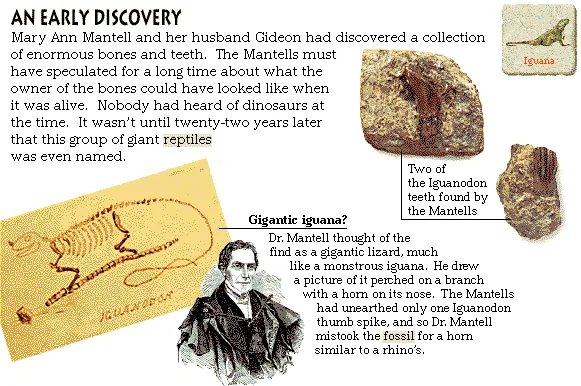
Mary Ann Mantell and her husband Gideon had discovered a collection of enormous bones and teeth. The Mantells must have speculated for a long time about what the owner of the bones could have looked like when it was alive. Nobody had heard of dinosaurs at the time. It wasn't until twenty-two years later that this group of giant reptiles was even named.

Gigantic iguana?Dr. Mantell thought of the find as a gigantic lizard, much like a monstrous iguana. He drew a picture of it perched on a branch with a horn on its nose. The Mantells had unearthed only one Iguanodon thumb spike, and so Dr. Mantell mistook the fossil for a horn similar to a rhino's.
Telltale Teeth

Telltale Teeth

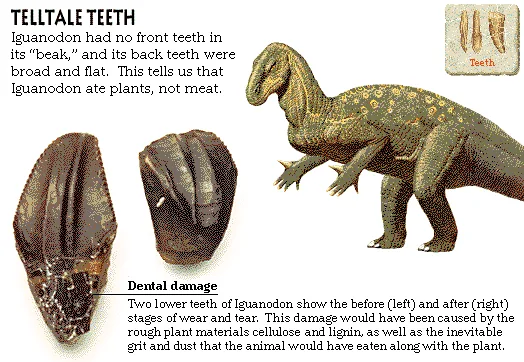
Iguanodon had no front teeth in its "beak," and its back teeth were broad and flat. This tells us that Iguanodon ate plants, not meat.

Dental damageTwo lower teeth of Iguanodon show the before (left) and after (right) stages of wear and tear. This damage would have been caused by the rough plant materials cellulose and lignin, as well as the inevitable grit and dust that the animal would have eaten along with the plant.

Explore more

Source: Microsoft Dinosaurs (1993) CD-ROM. Text liberated from original screen art; images & audio restored from disc. Original media is Microsoft/supplier copyright β€” non-commercial educational preservation. Credits & Acknowledgements