Microsoft Dinosaurs
Early Dinosaur Detectives

Meet the daring fossil hunters who first uncovered the world of dinosaurs.

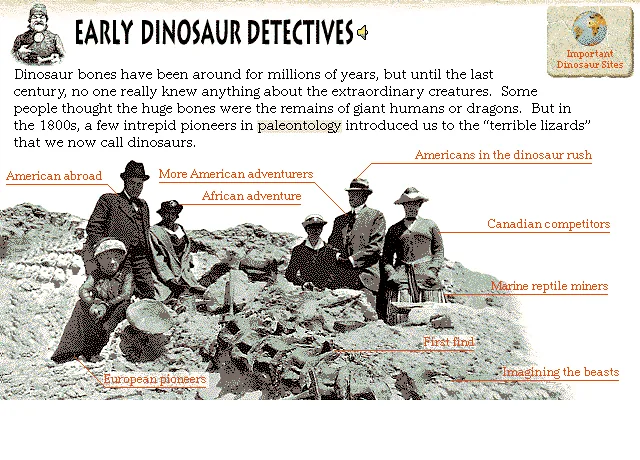
Dinosaur bones have been around for millions of years, but until the last century, no one really knew anything about the extraordinary creatures. Some people thought the huge bones were the remains of giant humans or dragons. But in the 1800s, a few intrepid pioneers in paleontology introduced us to the "terrible lizards" that we now call dinosaurs.

Explore

Imagining the Beasts

Imagining the Beasts

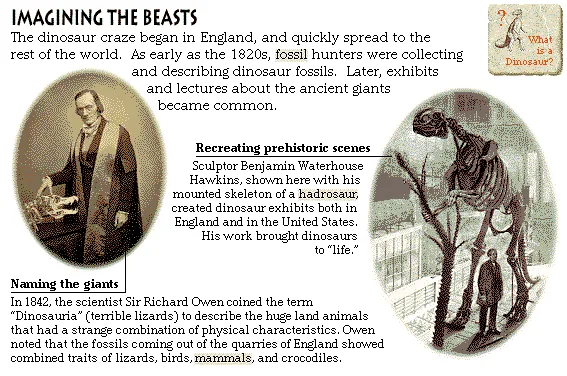
The dinosaur craze began in England, and quickly spread to the rest of the world. As early as the 1820s, fossil hunters were collecting and describing dinosaur fossils. Later, exhibits and lectures about the ancient giants became common.

Recreating prehistoric scenesSculptor Benjamin Waterhouse Hawkins, shown here with his mounted skeleton of a hadrosaur, created dinosaur exhibits both in England and in the United States. His work brought dinosaurs to "life."
Naming the giantsIn 1842, the scientist Sir Richard Owen coined the term "Dinosauria" ("terrible lizards") to describe the huge land animals that had a strange combination of physical characteristics. Owen noted that the fossils coming out of the quarries of England showed combined traits of lizards, birds, mammals, and crocodiles.
Marine Reptile Miners

Marine Reptile Miners

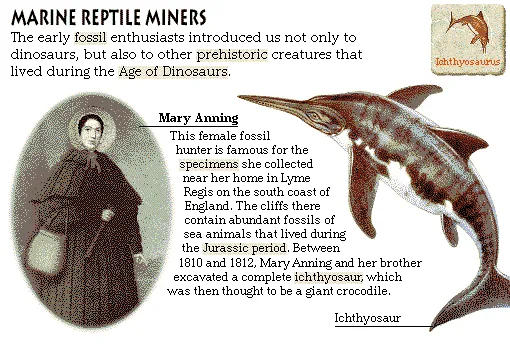
The early fossil enthusiasts introduced us not only to dinosaurs, but also to other prehistoric creatures that lived during the Age of Dinosaurs.

Mary AnningThis female fossil hunter is famous for the specimens she collected near her home in Lyme Regis on the south coast of England. The cliffs there contain abundant fossils of sea animals that lived during the Jurassic period. Between 1810 and 1812, Mary Anning and her brother excavated a complete ichthyosaur, which was then thought to be a giant crocodile.
Americans in the Dinosaur Rush

Americans in the Dinosaur Rush

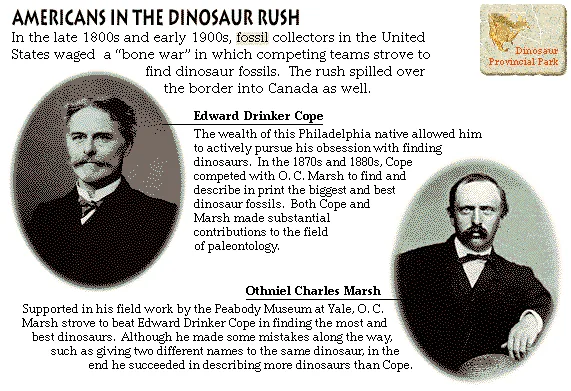
In the late 1800s and early 1900s, fossil collectors in the United States waged a "bone war" in which competing teams strove to find dinosaur fossils. The rush spilled over the border into Canada as well.

Edward Drinker CopeThe wealth of this Philadelphia native allowed him to actively pursue his obsession with finding dinosaurs. In the 1870s and 1880s, Cope competed with O. C. Marsh to find and describe in print the biggest and best dinosaur fossils. Both Cope and Marsh made substantial contributions to the field of paleontology.
Othniel Charles MarshSupported in his field work by the Peabody Museum at Yale, O. C. Marsh strove to beat Edward Drinker Cope in finding the most and best dinosaurs. Although he made some mistakes along the way, such as giving two different names to the same dinosaur, in the end he succeeded in describing more dinosaurs than Cope.
More American Adventurers

More American Adventurers

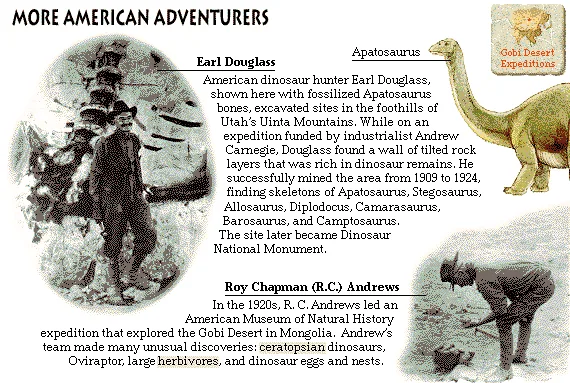
Earl DouglassAmerican dinosaur hunter Earl Douglass, shown here with fossilized Apatosaurus bones, excavated sites in the foothills of Utah's Uinta Mountains. While on an expedition funded by industrialist Andrew Carnegie, Douglass found a wall of tilted rock layers that was rich in dinosaur remains. He successfully mined the area from 1909 to 1924, finding skeletons of Apatosaurus, Stegosaurus, Allosaurus, Diplodocus, Camarasaurus, Barosaurus, and Camptosaurus. The site later became Dinosaur National Monument.
Roy Chapman (R.C.) AndrewsIn the 1920s, R. C. Andrews led an American Museum of Natural History expedition that explored the Gobi Desert in Mongolia. Andrew's team made many unusual discoveries: ceratopsian dinosaurs, Oviraptor, large herbivores, and dinosaur eggs and nests.
Canadian Competitors

Canadian Competitors

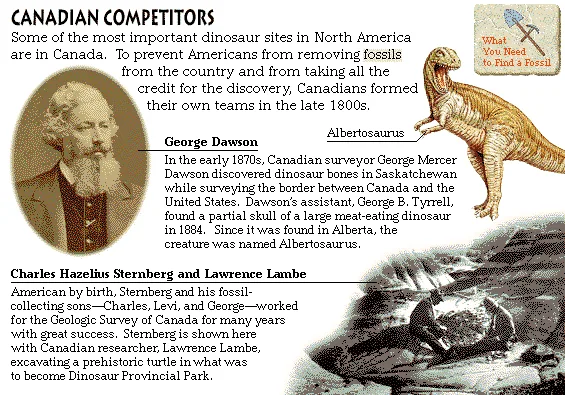
Some of the most important dinosaur sites in North America are in Canada. To prevent Americans from removing fossils from the country and from taking all the credit for the discovery, Canadians formed their own teams in the late 1800s.

George DawsonIn the early 1870s, Canadian surveyor George Mercer Dawson discovered dinosaur bones in Saskatchewan while surveying the border between Canada and the United States. Dawson's assistant, George B. Tyrrell, found a partial skull of a large meat-eating dinosaur in 1884. Since it was found in Alberta, the creature was named Albertosaurus.
Charles Hazelius Sternberg and Lawrence LambeAmerican by birth, Sternberg and his fossil-collecting sons—Charles, Levi, and George—worked for the Geologic Survey of Canada for many years with great success. Sternberg is shown here with Canadian researcher, Lawrence Lambe, excavating a prehistoric turtle in what was to become Dinosaur Provincial Park.
European Pioneers

European Pioneers

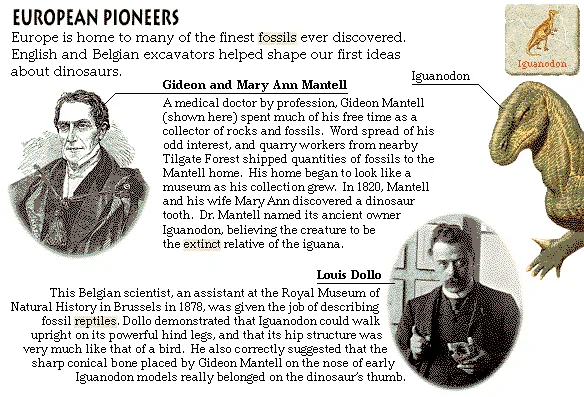
Europe is home to many of the finest fossils ever discovered. English and Belgian excavators helped shape our first ideas about dinosaurs.

Gideon and Mary Ann MantellA medical doctor by profession, Gideon Mantell (shown here) spent much of his free time as a collector of rocks and fossils. Word spread of his odd interest, and quarry workers from nearby Tilgate Forest shipped quantities of fossils to the Mantell home. His home began to look like a museum as his collection grew. In 1820, Mantell and his wife Mary Ann discovered a dinosaur tooth. Dr. Mantell named its ancient owner Iguanodon, believing the creature to be the extinct relative of the iguana.
Louis DolloThis Belgian scientist, an assistant at the Royal Museum of Natural History in Brussels in 1878, was given the job of describing fossil reptiles. Dollo demonstrated that Iguanodon could walk upright on its powerful hind legs, and that its hip structure was very much like that of a bird. He also correctly suggested that the sharp conical bone placed by Gideon Mantell on the nose of early Iguanodon models really belonged on the dinosaur's thumb.
African Adventure

African Adventure

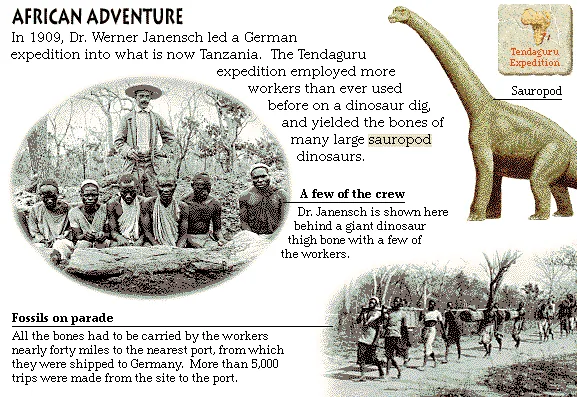
In 1909, Dr. Werner Janensch led a German expedition into what is now Tanzania. The Tendaguru expedition employed more workers than ever used before on a dinosaur dig, and yielded the bones of many large sauropod dinosaurs.

A few of the crewDr. Janensch is shown here behind a giant dinosaur thigh bone with a few of the workers.
Fossils on paradeAll the bones had to be carried by the workers nearly forty miles to the nearest port, from which they were shipped to Germany. More than 5,000 trips were made from the site to the port.
American Abroad

American Abroad

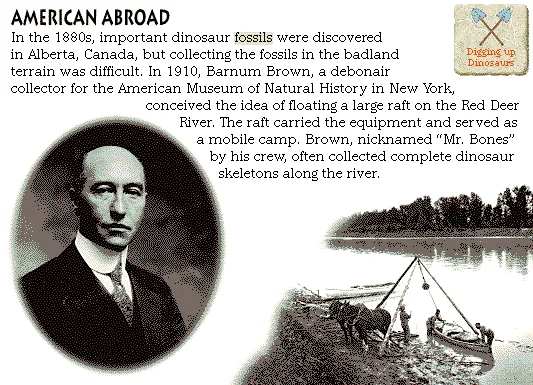
In the 1880s, important dinosaur fossils were discovered in Alberta, Canada, but collecting the fossils in the badland terrain was difficult. In 1910, Barnum Brown, a debonair collector for the American Museum of Natural History in New York, conceived the idea of floating a large raft on the Red Deer River. The raft carried the equipment and served as a mobile camp. Brown, nicknamed "Mr. Bones" by his crew, often collected complete dinosaur skeletons along the river.

First Find

First Find

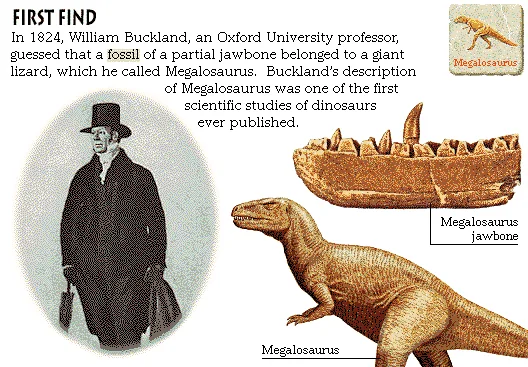
In 1824, William Buckland, an Oxford University professor, guessed that a fossil of a partial jawbone belonged to a giant lizard, which he called Megalosaurus. Buckland's description of Megalosaurus was one of the first scientific studies of dinosaurs ever published.

Explore more

Source: Microsoft Dinosaurs (1993) CD-ROM. Text liberated from original screen art; images & audio restored from disc. Original media is Microsoft/supplier copyright — non-commercial educational preservation. Credits & Acknowledgements