Microsoft Dinosaurs
Hypsilophodon
Hypsilophodon
Hypsilophodon

hip-SIL-oh-FOH-don name means β€œHigh ridge tooth”

This gazelle-like sprinter was one of the longest-surviving dinosaurs β€” and one of the fastest!

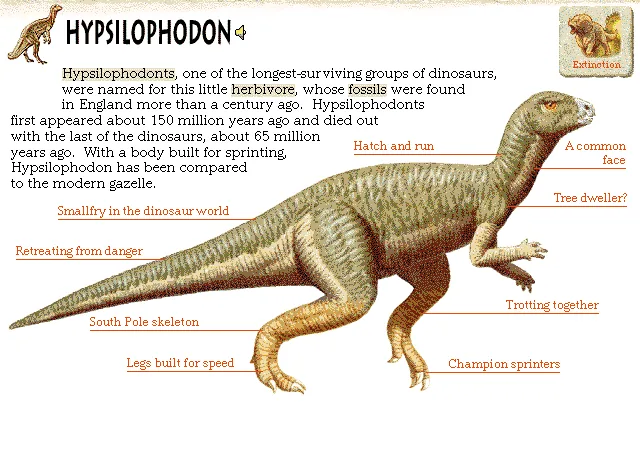
Hypsilophodonts, one of the longest-surviving groups of dinosaurs, were named for this little herbivore, whose fossils were found in England more than a century ago. Hypsilophodonts first appeared about 150 million years ago and died out with the last of the dinosaurs, about 65 million years ago. With a body built for sprinting, Hypsilophodon has been compared to the modern gazelle.

Explore

Tree Dweller?

Tree Dweller?

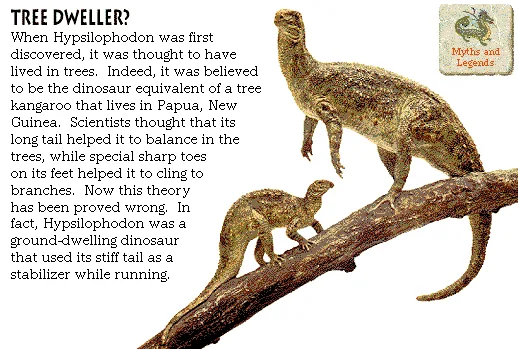
When Hypsilophodon was first discovered, it was thought to have lived in trees. Indeed, it was believed to be the dinosaur equivalent of a tree kangaroo that lives in Papua, New Guinea. Scientists thought that its long tail helped it to balance in the trees, while special sharp toes on its feet helped it to cling to branches. Now this theory has been proved wrong. In fact, Hypsilophodon was a ground-dwelling dinosaur that used its stiff tail as a stabilizer while running.
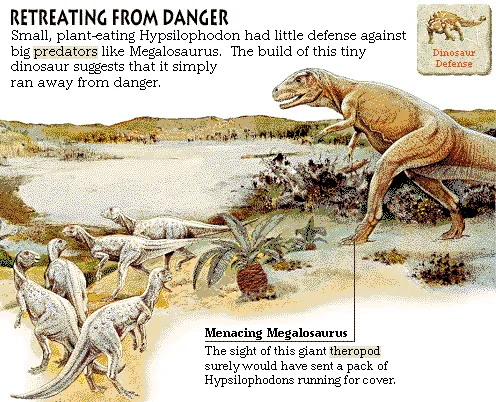
Retreating from Danger

Retreating from Danger

Small, plant-eating Hypsilophodon had little defense against big predators like Megalosaurus. The build of this tiny dinosaur suggests that it simply ran away from danger.

Menacing MegalosaurusThe sight of this giant theropod surely would have sent a pack of Hypsilophodons running for cover.
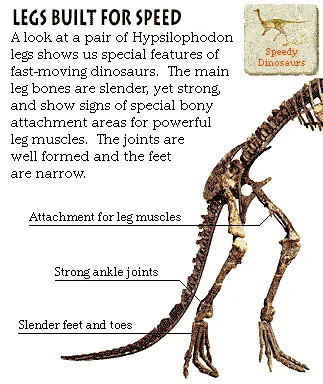
Legs Built for Speed

Legs Built for Speed

A look at a pair of Hypsilophodon legs shows us special features of fast-moving dinosaurs. The main leg bones are slender, yet strong, and show signs of special bony attachment areas for powerful leg muscles. The joints are well formed and the feet are narrow.

Smallfry in the Dinosaur World

Smallfry in the Dinosaur World

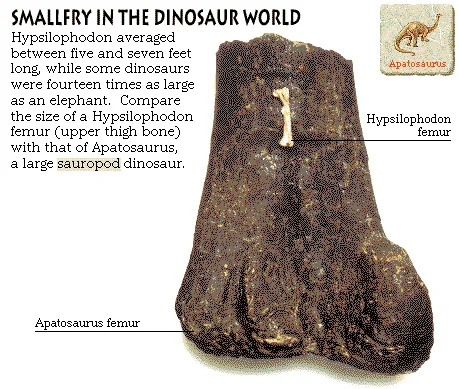
Hypsilophodon averaged between five and seven feet long, while some dinosaurs were fourteen times as large as an elephant. Compare the size of a Hypsilophodon femur (upper thigh bone) with that of Apatosaurus, a large sauropod dinosaur.

Champion Sprinters

Champion Sprinters

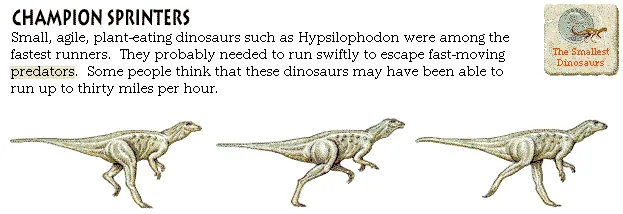
Small, agile, plant-eating dinosaurs such as Hypsilophodon were among the fastest runners. They probably needed to run swiftly to escape fast-moving predators. Some people think that these dinosaurs may have been able to run up to thirty miles per hour.

Hatch and Run

Hatch and Run

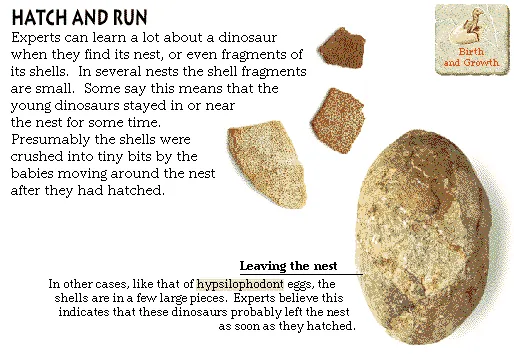
Experts can learn a lot about a dinosaur when they find its nest, or even fragments of its shells. In several nests the shell fragments are small. Some say this means that the young dinosaurs stayed in or near the nest for some time. Presumably the shells were crushed into tiny bits by the babies moving around the nest after they had hatched.

Leaving the nestIn other cases, like that of hypsilophodont eggs, the shells are in a few large pieces. Experts believe this indicates that these dinosaurs probably left the nest as soon as they hatched.
A Common Face

A Common Face

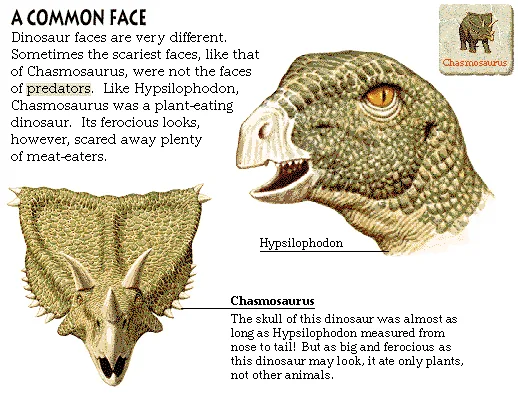
Dinosaur faces are very different. Sometimes the scariest faces, like that of Chasmosaurus, were not the faces of predators. Like Hypsilophodon, Chasmosaurus was a plant-eating dinosaur. Its ferocious looks, however, scared away plenty of meat-eaters.

ChasmosaurusThe skull of this dinosaur was almost as long as Hypsilophodon measured from nose to tail! But as big and ferocious as this dinosaur may look, it ate only plants, not other animals.
Trotting Together

Trotting Together

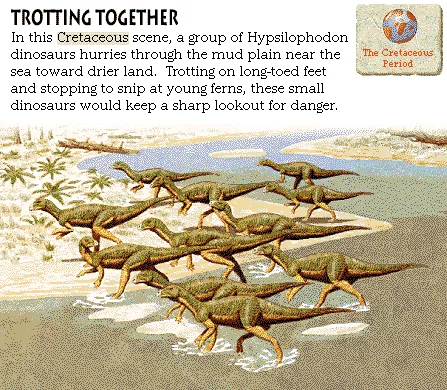
In this Cretaceous scene, a group of Hypsilophodon dinosaurs hurries through the mud plain near the sea toward drier land. Trotting on long-toed feet and stopping to snip at young ferns, these small dinosaurs would keep a sharp lookout for danger.

South Pole Skeleton

South Pole Skeleton

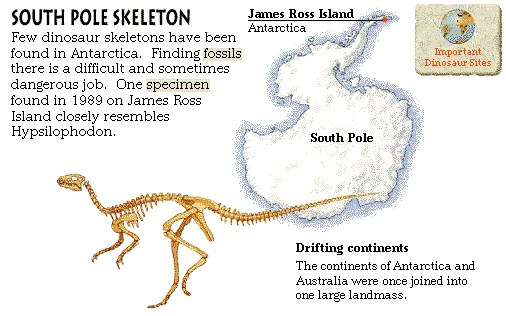
Few dinosaur skeletons have been found in Antarctica. Finding fossils there is a difficult and sometimes dangerous job. One specimen found in 1989 on James Ross Island closely resembles Hypsilophodon.

Drifting continentsThe continents of Antarctica and Australia were once joined into one large landmass.

Explore more

Source: Microsoft Dinosaurs (1993) CD-ROM. Text liberated from original screen art; images & audio restored from disc. Original media is Microsoft/supplier copyright β€” non-commercial educational preservation. Credits & Acknowledgements