Microsoft Dinosaurs
Speedy Dinosaurs
Speedy Dinosaurs

SPEE-dee DY-nuh-SORS

More than half of all dinosaurs were built to run fast—sprinting on two legs to chase prey or escape danger!

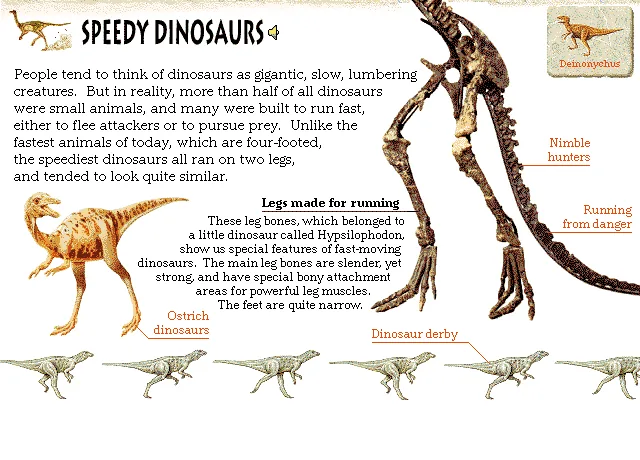
People tend to think of dinosaurs as gigantic, slow, lumbering creatures. But in reality, more than half of all dinosaurs were small animals, and many were built to run fast, either to flee attackers or to pursue prey. Unlike the fastest animals of today, which are four-footed, the speediest dinosaurs all ran on two legs, and tended to look quite similar.

Explore

Dinosaur Derby

Dinosaur Derby

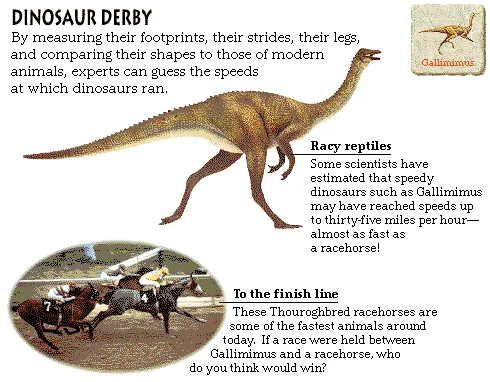
By measuring their footprints, their strides, their legs, and comparing their shapes to those of modern animals, experts can guess the speeds at which dinosaurs ran.

Racy reptilesSome scientists have estimated that speedy dinosaurs such as Gallimimus may have reached speeds up to thirty-five miles per hour—almost as fast as a racehorse!
To the finish lineThese Thoroughbred racehorses are some of the fastest animals around today. If a race were held between Gallimimus and a racehorse, who do you think would win?
Ostrich Dinosaurs

Ostrich Dinosaurs

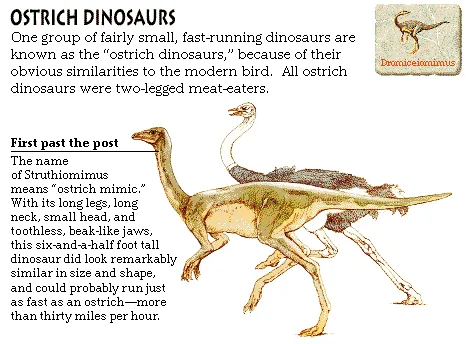
One group of fairly small, fast-running dinosaurs are known as the "ostrich dinosaurs," because of their obvious similarities to the modern bird. All ostrich dinosaurs were two-legged meat-eaters.

First past the postThe name of Struthiomimus means "ostrich mimic." With its long legs, long neck, small head, and toothless, beak-like jaws, this six-and-a-half foot tall dinosaur did look remarkably similar in size and shape, and could probably run just as fast as an ostrich—more than thirty miles per hour.
Nimble Hunters

Nimble Hunters

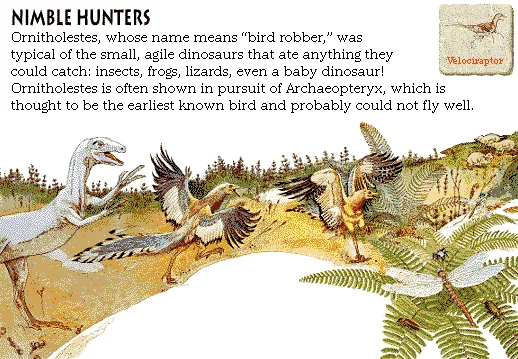
Ornitholestes, whose name means "bird robber," was typical of the small, agile dinosaurs that ate anything they could catch: insects, frogs, lizards, even a baby dinosaur! Ornitholestes is often shown in pursuit of Archaeopteryx, which is thought to be the earliest known bird and probably could not fly well.

Running from Danger

Running from Danger

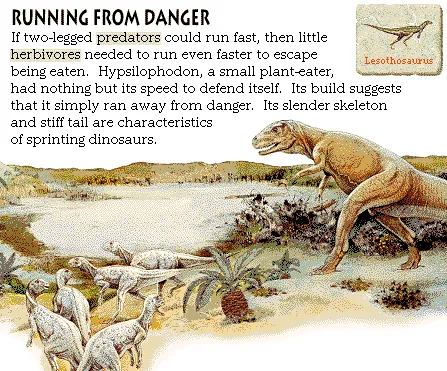
If two-legged predators could run fast, then little herbivores needed to run even faster to escape being eaten. Hypsilophodon, a small plant-eater, had nothing but its speed to defend itself. Its build suggests that it simply ran away from danger. Its slender skeleton and stiff tail are characteristics of sprinting dinosaurs.

Explore more

Source: Microsoft Dinosaurs (1993) CD-ROM. Text liberated from original screen art; images & audio restored from disc. Original media is Microsoft/supplier copyright — non-commercial educational preservation. Credits & Acknowledgements