Microsoft Dinosaurs
Apatosaurus
Apatosaurus
Apatosaurus

ah-PAT-oh-SOR-us name means “Deceptive lizard”

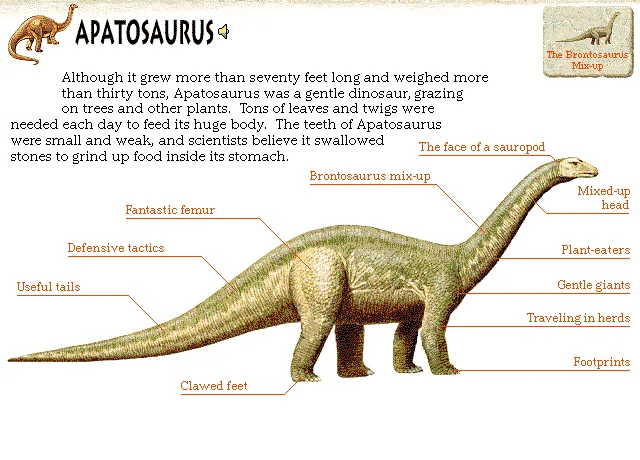
A gentle giant that could whip predators away with its mighty eighty-two-bone tail!

KindDinosaur Period Late Jurassic Diet Herbivore

Although it grew more than seventy feet long and weighed more than thirty tons, Apatosaurus was a gentle dinosaur, grazing on trees and other plants. Tons of leaves and twigs were needed each day to feed its huge body. The teeth of Apatosaurus were small and weak, and scientists believe it swallowed stones to grind up food inside its stomach.

Explore

Footprints

Footprints

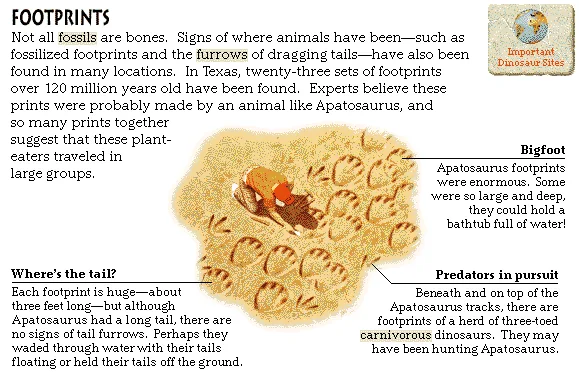
Not all fossils are bones. Signs of where animals have been—such as fossilized footprints and the furrows of dragging tails—have also been found in many locations. In Texas, twenty-three sets of footprints over 120 million years old have been found. Experts believe these prints were probably made by an animal like Apatosaurus, and so many prints together suggest that these plant-eaters traveled in large groups.

BigfootApatosaurus footprints were enormous. Some were so large and deep, they could hold a bathtub full of water!
Where's the tail?Each footprint is huge—about three feet long—but although Apatosaurus had a long tail, there are no signs of tail furrows. Perhaps they waded through water with their tails floating or held their tails off the ground.
Predators in pursuitBeneath and on top of the Apatosaurus tracks, there are footprints of a herd of three-toed carnivorous dinosaurs. They may have been hunting Apatosaurus.
Brontosaurus Mix-Up

Brontosaurus Mix-Up

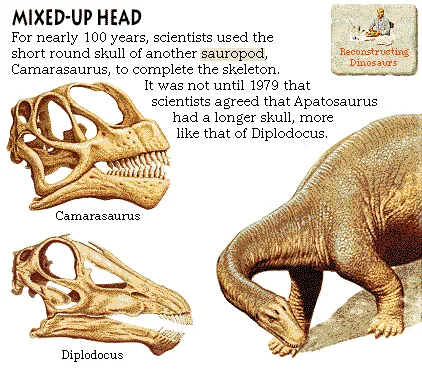
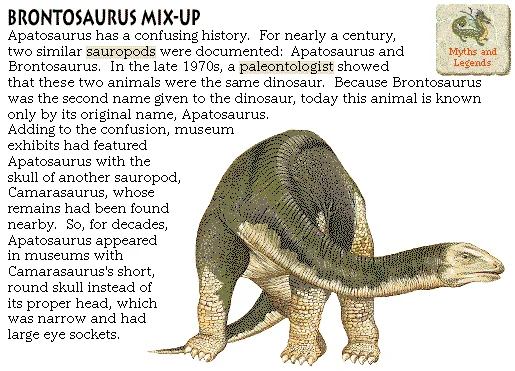
Apatosaurus has a confusing history. For nearly a century, two similar sauropods were documented: Apatosaurus and Brontosaurus. In the late 1970s, a paleontologist showed that these two animals were the same dinosaur. Because Brontosaurus was the second name given to the dinosaur, today this animal is known only by its original name, Apatosaurus. Adding to the confusion, museum exhibits had featured Apatosaurus with the skull of another sauropod, Camarasaurus, whose remains had been found nearby. So, for decades, Apatosaurus appeared in museums with Camarasaurus's short, round skull instead of its proper head, which was narrow and had large eye sockets.

Clawed Feet

Clawed Feet

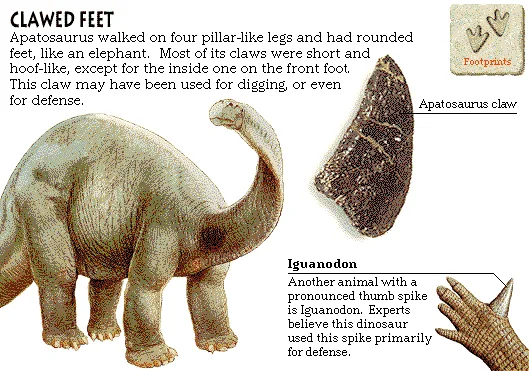
Apatosaurus walked on four pillar-like legs and had rounded feet, like an elephant. Most of its claws were short and hoof-like, except for the inside one on the front foot. This claw may have been used for digging, or even for defense.

IguanodonAnother animal with a pronounced thumb spike is Iguanodon. Experts believe this dinosaur used this spike primarily for defense.
Gentle Giants

Gentle Giants

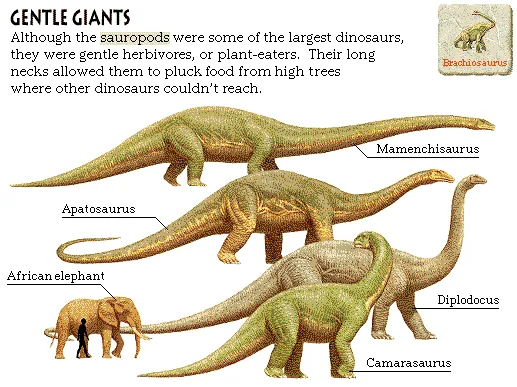
Although the sauropods were some of the largest dinosaurs, they were gentle herbivores, or plant-eaters. Their long necks allowed them to pluck food from high trees where other dinosaurs couldn't reach.

Traveling in Herds

Traveling in Herds

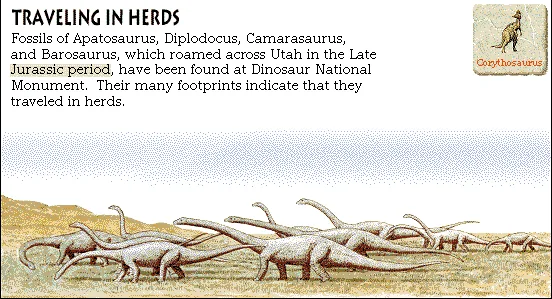
Fossils of Apatosaurus, Diplodocus, Camarasaurus, and Barosaurus, which roamed across Utah in the Late Jurassic period, have been found at Dinosaur National Monument. Their many footprints indicate that they traveled in herds.

Useful Tails

Useful Tails

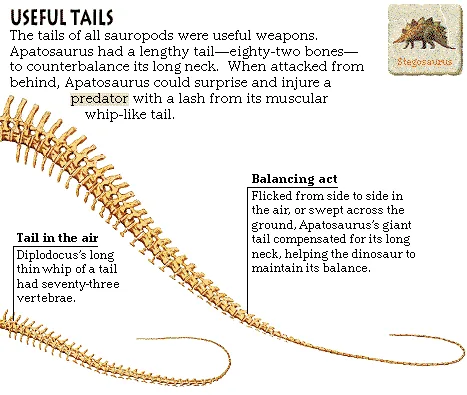
The tails of all sauropods were useful weapons. Apatosaurus had a lengthy tail—eighty-two bones—to counterbalance its long neck. When attacked from behind, Apatosaurus could surprise and injure a predator with a lash from its muscular whip-like tail.

Tail in the airDiplodocus's long thin whip of a tail had seventy-three vertebrae.
Balancing actFlicked from side to side in the air, or swept across the ground, Apatosaurus's giant tail compensated for its long neck, helping the dinosaur to maintain its balance.
Defensive Tactics

Defensive Tactics

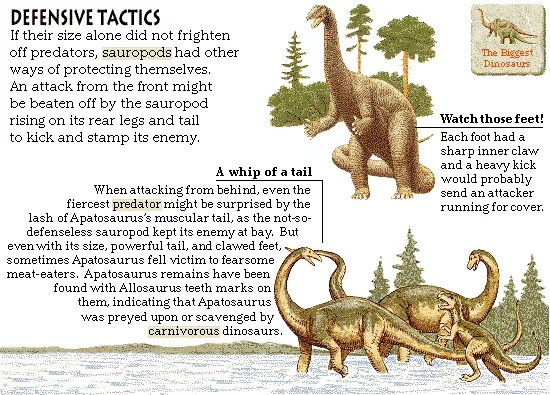
If their size alone did not frighten off predators, sauropods had other ways of protecting themselves. An attack from the front might be beaten off by the sauropod rising on its rear legs and tail to kick and stamp its enemy.

A whip of a tailWhen attacking from behind, even the fiercest predator might be surprised by the lash of Apatosaurus's muscular tail, as the not-so-defenseless sauropod kept its enemy at bay. But even with its size, powerful tail, and clawed feet, sometimes Apatosaurus fell victim to fearsome meat-eaters. Apatosaurus remains have been found with Allosaurus teeth marks on them, indicating that Apatosaurus was preyed upon or scavenged by carnivorous dinosaurs.
Watch those feet!Each foot had a sharp inner claw and a heavy kick would probably send an attacker running for cover.
The Face of a Sauropod

The Face of a Sauropod

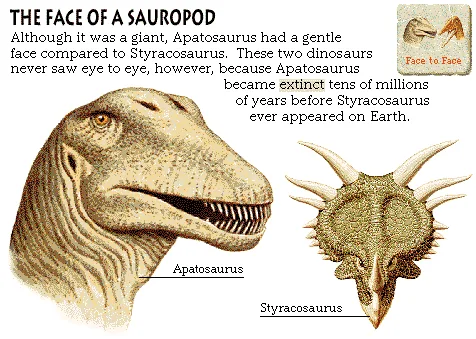
Although it was a giant, Apatosaurus had a gentle face compared to Styracosaurus. These two dinosaurs never saw eye to eye, however, because Apatosaurus became extinct tens of millions of years before Styracosaurus ever appeared on Earth.

Plant-Eaters

Plant-Eaters

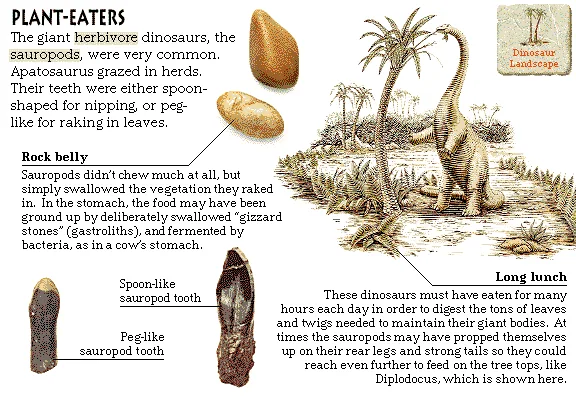
The giant herbivore dinosaurs, the sauropods, were very common. Apatosaurus grazed in herds. Their teeth were either spoon-shaped for nipping, or peg-like for raking in leaves.

Rock bellySauropods didn't chew much at all, but simply swallowed the vegetation they raked in. In the stomach, the food may have been ground up by deliberately swallowed "gizzard stones" (gastroliths), and fermented by bacteria, as in a cow's stomach.
Long lunchThese dinosaurs must have eaten for many hours each day in order to digest the tons of leaves and twigs needed to maintain their giant bodies. At times the sauropods may have propped themselves up on their rear legs and strong tails so they could reach even further to feed on the tree tops, like Diplodocus, which is shown here.
Fantastic Femur

Fantastic Femur

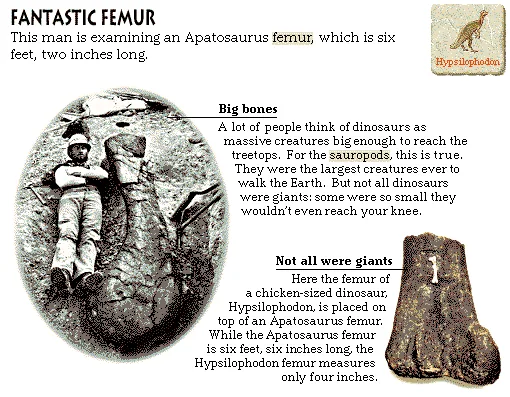
This man is examining an Apatosaurus femur, which is six feet, two inches long.

Big bonesA lot of people think of dinosaurs as massive creatures big enough to reach the treetops. For the sauropods, this is true. They were the largest creatures ever to walk the Earth. But not all dinosaurs were giants: some were so small they wouldn't even reach your knee.
Not all were giantsHere the femur of a chicken-sized dinosaur, Hypsilophodon, is placed on top of an Apatosaurus femur. While the Apatosaurus femur is six feet, six inches long, the Hypsilophodon femur measures only four inches.
Mixed-Up Head

Mixed-Up Head

For nearly 100 years, scientists used the short round skull of another sauropod, Camarasaurus, to complete the skeleton. It was not until 1979 that scientists agreed that Apatosaurus had a longer skull, more like that of Diplodocus.

Explore more

Source: Microsoft Dinosaurs (1993) CD-ROM. Text liberated from original screen art; images & audio restored from disc. Original media is Microsoft/supplier copyright — non-commercial educational preservation. Credits & Acknowledgements