Treasured Find
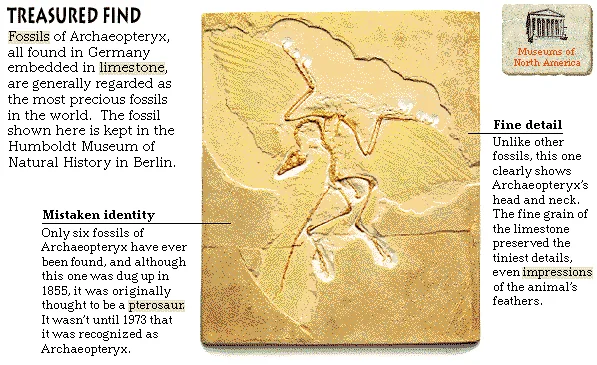
Fossils of Archaeopteryx, all found in Germany embedded in limestone, are generally regarded as the most precious fossils in the world. The fossil shown here is kept in the Humboldt Museum of Natural History in Berlin.
Half dinosaur, half bird — Archaeopteryx was nature's most amazing experiment!
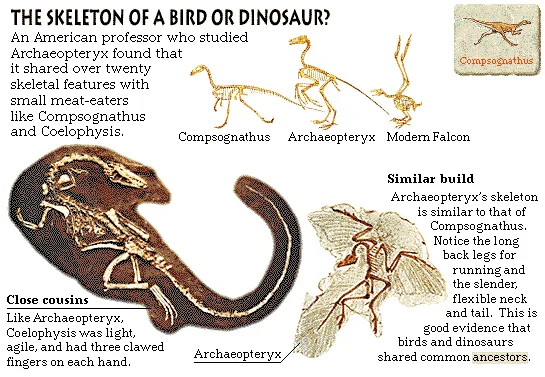
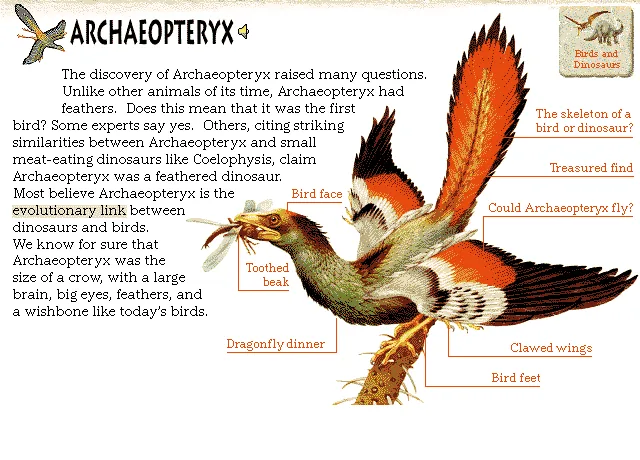
The discovery of Archaeopteryx raised many questions. Unlike other animals of its time, Archaeopteryx had feathers. Does this mean that it was the first bird? Some experts say yes. Others, citing striking similarities between Archaeopteryx and small meat-eating dinosaurs like Coelophysis, claim Archaeopteryx was a feathered dinosaur. Most believe Archaeopteryx is the evolutionary link between dinosaurs and birds. We know for sure that Archaeopteryx was the size of a crow, with a large brain, big eyes, feathers, and a wishbone like today's birds.

Fossils of Archaeopteryx, all found in Germany embedded in limestone, are generally regarded as the most precious fossils in the world. The fossil shown here is kept in the Humboldt Museum of Natural History in Berlin.

An American professor who studied Archaeopteryx found that it shared over twenty skeletal features with small meat-eaters like Compsognathus and Coelophysis.

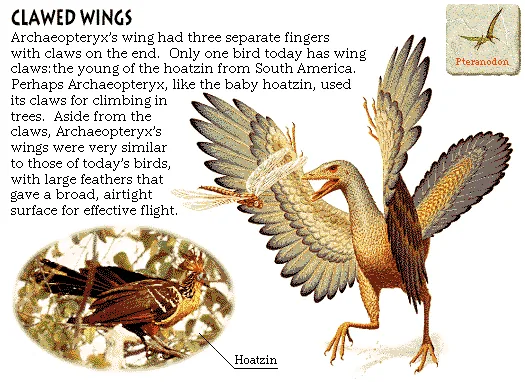
Archaeopteryx's wing had three separate fingers with claws on the end. Only one bird today has wing claws: the young of the hoatzin from South America. Perhaps Archaeopteryx, like the baby hoatzin, used its claws for climbing in trees. Aside from the claws, Archaeopteryx's wings were very similar to those of today's birds, with large feathers that gave a broad, airtight surface for effective flight.

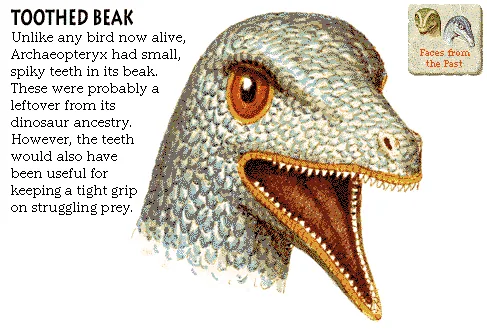
Unlike any bird now alive, Archaeopteryx had small, spiky teeth in its beak. These were probably a leftover from its dinosaur ancestry. However, the teeth would also have been useful for keeping a tight grip on struggling prey.

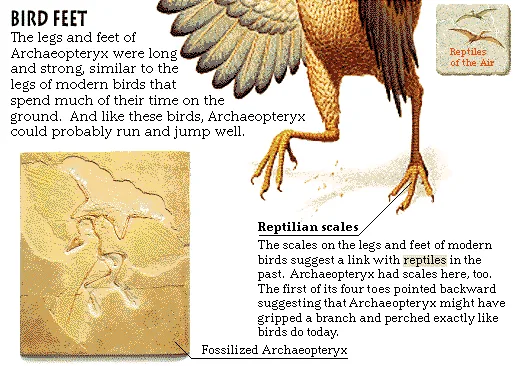
The legs and feet of Archaeopteryx were long and strong, similar to the legs of modern birds that spend much of their time on the ground. And like these birds, Archaeopteryx could probably run and jump well.

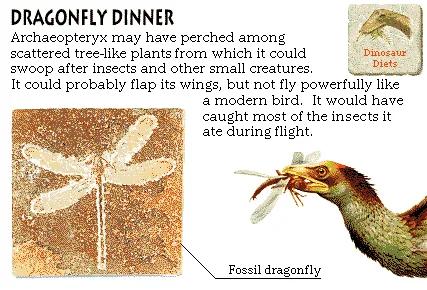
Archaeopteryx may have perched among scattered tree-like plants from which it could swoop after insects and other small creatures. It could probably flap its wings, but not fly powerfully like a modern bird. It would have caught most of the insects it ate during flight.

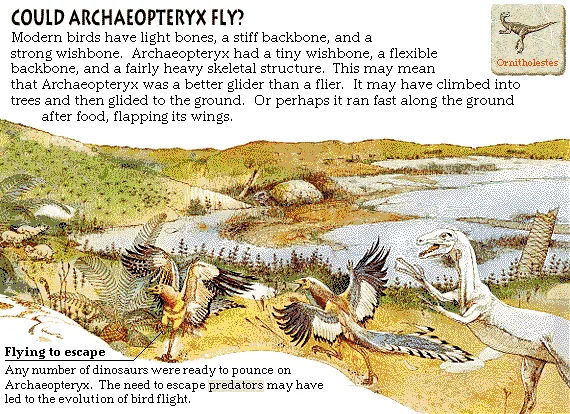
Modern birds have light bones, a stiff backbone, and a strong wishbone. Archaeopteryx had a tiny wishbone, a flexible backbone, and a fairly heavy skeletal structure. This may mean that Archaeopteryx was a better glider than a flier. It may have climbed into trees and then glided to the ground. Or perhaps it ran fast along the ground after food, flapping its wings.

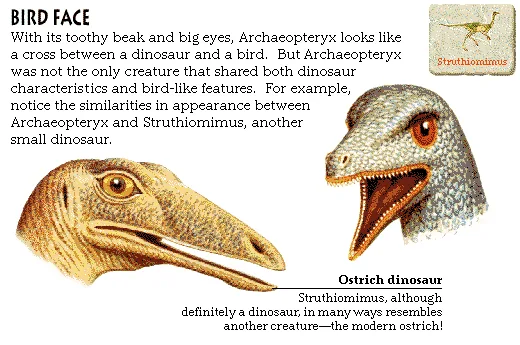
With its toothy beak and big eyes, Archaeopteryx looks like a cross between a dinosaur and a bird. But Archaeopteryx was not the only creature that shared both dinosaur characteristics and bird-like features. For example, notice the similarities in appearance between Archaeopteryx and Struthiomimus, another small dinosaur.
Source: Microsoft Dinosaurs (1993) CD-ROM. Text liberated from original screen art; images & audio restored from disc. Original media is Microsoft/supplier copyright — non-commercial educational preservation. Credits & Acknowledgements