Academy of Natural Sciences
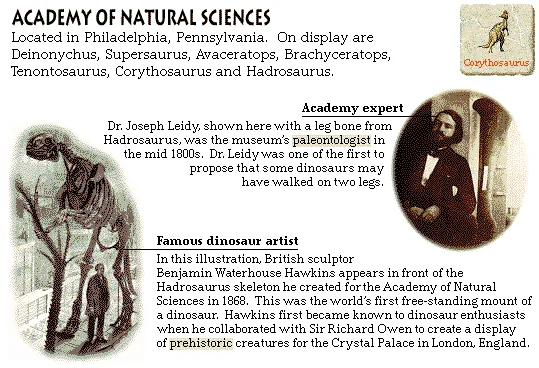
Located in Philadelphia, Pennsylvania. On display are Deinonychus, Supersaurus, Avaceratops, Brachyceratops, Tenontosaurus, Corythosaurus and Hadrosaurus.
Discover where to find real dinosaur bones near you!
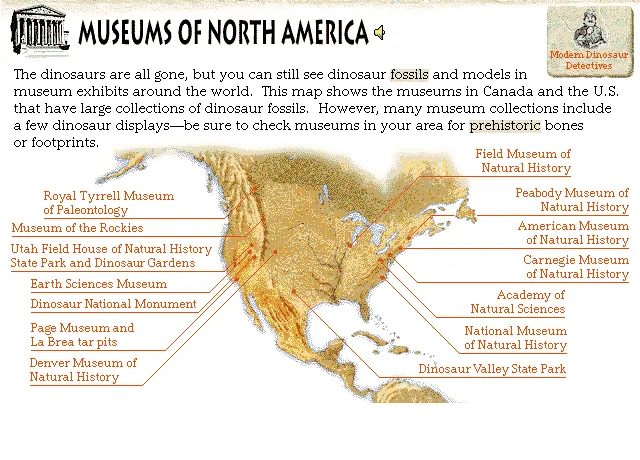
The dinosaurs are all gone, but you can still see dinosaur fossils and models in museum exhibits around the world. This map shows the museums in Canada and the U.S. that have large collections of dinosaur fossils. However, many museum collections include a few dinosaur displays—be sure to check museums in your area for prehistoric bones or footprints.

Located in Philadelphia, Pennsylvania. On display are Deinonychus, Supersaurus, Avaceratops, Brachyceratops, Tenontosaurus, Corythosaurus and Hadrosaurus.

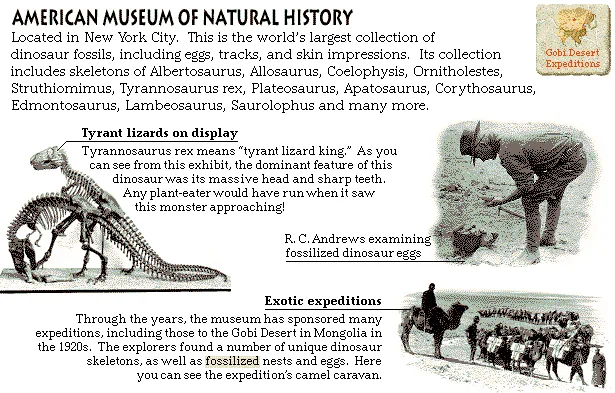
Located in New York City. This is the world's largest collection of dinosaur fossils, including eggs, tracks, and skin impressions. Its collection includes skeletons of Albertosaurus, Allosaurus, Coelophysis, Ornitholestes, Struthiomimus, Tyrannosaurus rex, Plateosaurus, Apatosaurus, Corythosaurus, Edmontosaurus, Lambeosaurus, Saurolophus and many more.

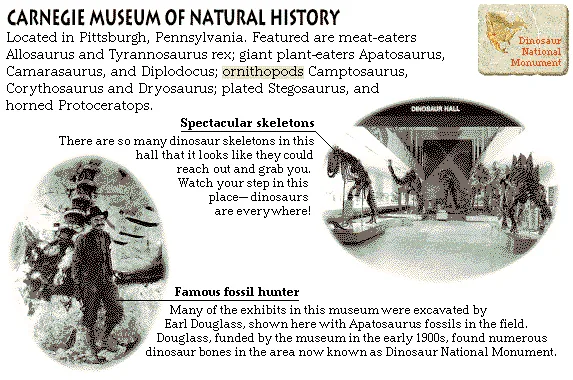
Located in Pittsburgh, Pennsylvania. Featured are meat-eaters Allosaurus and Tyrannosaurus rex; giant plant-eaters Apatosaurus, Camarasaurus, and Diplodocus; ornithopods Camptosaurus, Corythosaurus and Dryosaurus; plated Stegosaurus, and horned Protoceratops.

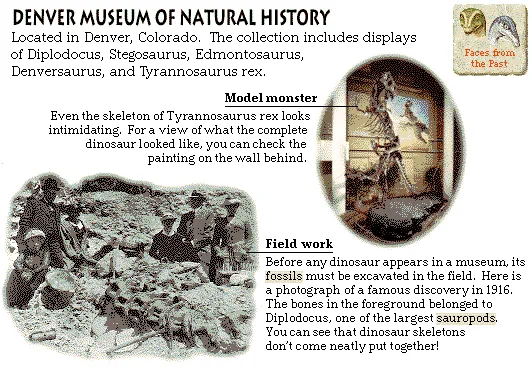
Located in Denver, Colorado. The collection includes displays of Diplodocus, Stegosaurus, Edmontosaurus, Denversaurus, and Tyrannosaurus rex.

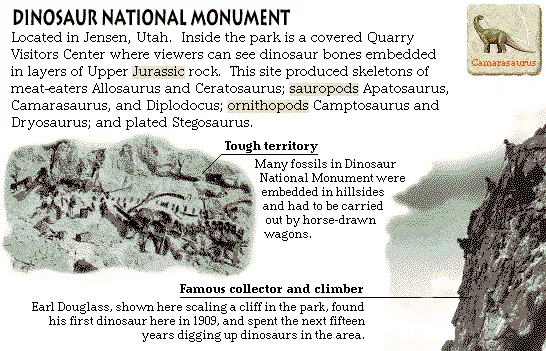
Located in Jensen, Utah. Inside the park is a covered Quarry Visitors Center where viewers can see dinosaur bones embedded in layers of Upper Jurassic rock. This site produced skeletons of meat-eaters Allosaurus and Ceratosaurus; sauropods Apatosaurus, Camarasaurus, and Diplodocus; ornithopods Camptosaurus and Dryosaurus; and plated Stegosaurus.

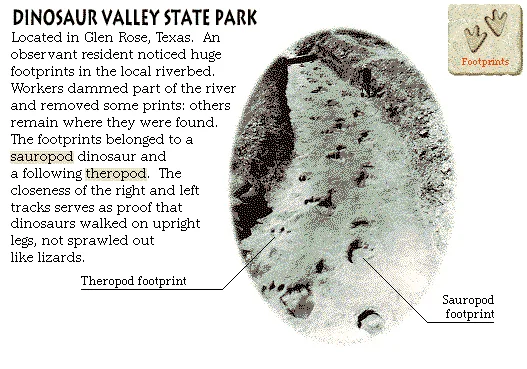
Located in Glen Rose, Texas. An observant resident noticed huge footprints in the local riverbed. Workers dammed part of the river and removed some prints; others remain where they were found. The footprints belonged to a sauropod dinosaur and a following theropod. The closeness of the right and left tracks serves as proof that dinosaurs walked on upright legs, not sprawled out like lizards.

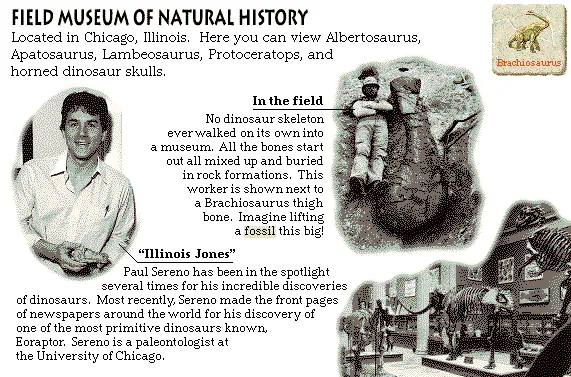
Located in Chicago, Illinois. Here you can view Albertosaurus, Apatosaurus, Lambeosaurus, Protoceratops, and horned dinosaur skulls.

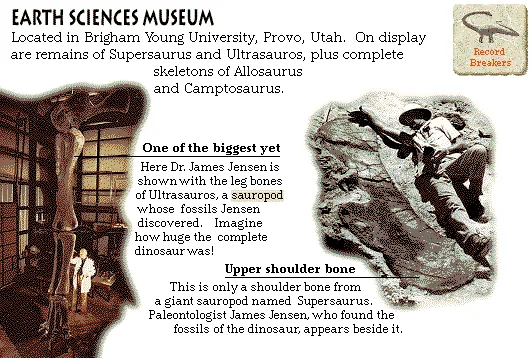
Located in Brigham Young University, Provo, Utah. On display are remains of Supersaurus and Ultrasauros, plus complete skeletons of Allosaurus and Camptosaurus.

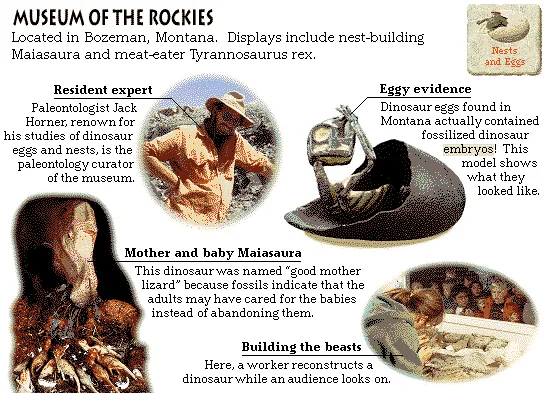
Located in Bozeman, Montana. Displays include nest-building Maiasaura and meat-eater Tyrannosaurus rex.

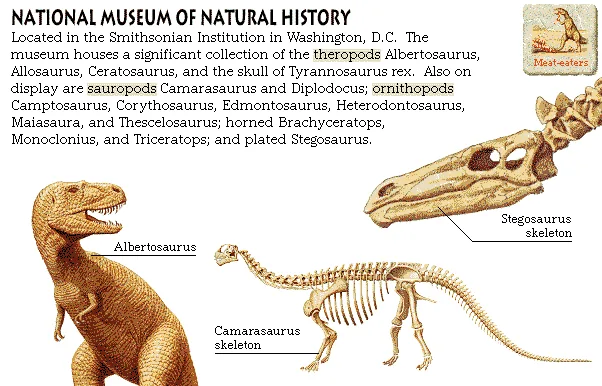
Located in the Smithsonian Institution in Washington, D.C. The museum houses a significant collection of the theropods Albertosaurus, Allosaurus, Ceratosaurus, and the skull of Tyrannosaurus rex. Also on display are sauropods Camarasaurus and Diplodocus; ornithopods Camptosaurus, Corythosaurus, Edmontosaurus, Heterodontosaurus, Maiasaura, and Thescelosaurus; horned Brachyceratops, Monoclonius, and Triceratops; and plated Stegosaurus.

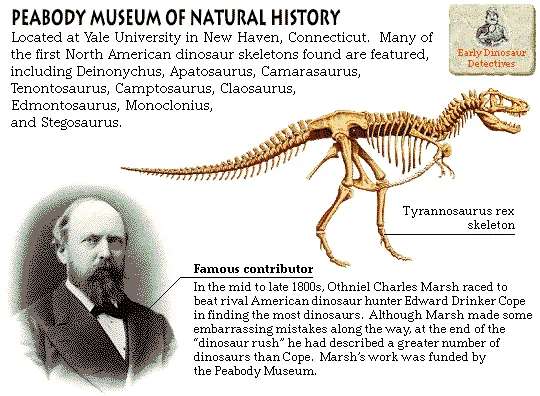
Located at Yale University in New Haven, Connecticut. Many of the first North American dinosaur skeletons found are featured, including Deinonychus, Apatosaurus, Carnarasaurus, Tenontosaurus, Camptosaurus, Claosaurus, Edmontosaurus, Monoclonius, and Stegosaurus.

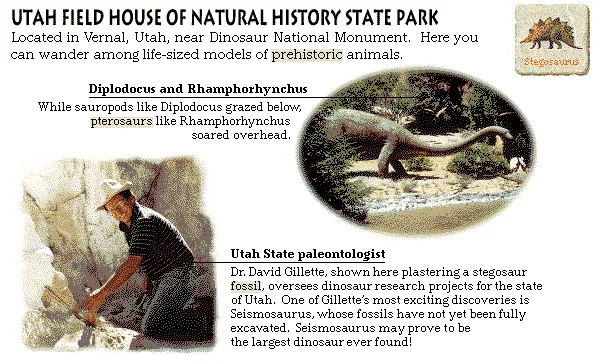
Located in Vernal, Utah, near Dinosaur National Monument. Here you can wander among life-sized models of prehistoric animals.

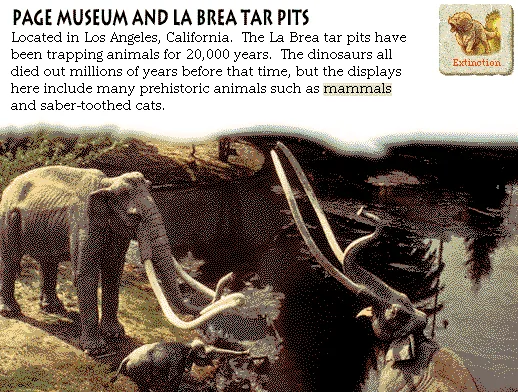
Located in Los Angeles, California. The La Brea tar pits have been trapping animals for 20,000 years. The dinosaurs all died out millions of years before that time, but the displays here include many prehistoric animals such as mammals and saber-toothed cats.

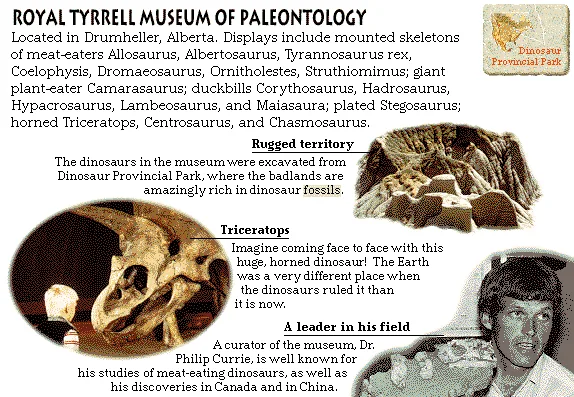
Located in Drumheller, Alberta. Displays include mounted skeletons of meat-eaters Allosaurus, Albertosaurus, Tyrannosaurus rex, Coelophysis, Dromaeosaurus, Ornitholestes, Struthiomimus; giant plant-eater Camarasaurus; duckbills Corythosaurus, Hadrosaurus, Hypacrosaurus, Lambeosaurus, and Maiasaura; plated Stegosaurus; horned Triceratops, Centrosaurus, and Chasmosaurus.
Source: Microsoft Dinosaurs (1993) CD-ROM. Text liberated from original screen art; images & audio restored from disc. Original media is Microsoft/supplier copyright — non-commercial educational preservation. Credits & Acknowledgements