Microsoft Dinosaurs
The American Dinosaur Rush

Two rival scientists sparked a wild race to dig up the biggest dinosaur bones in the American West!

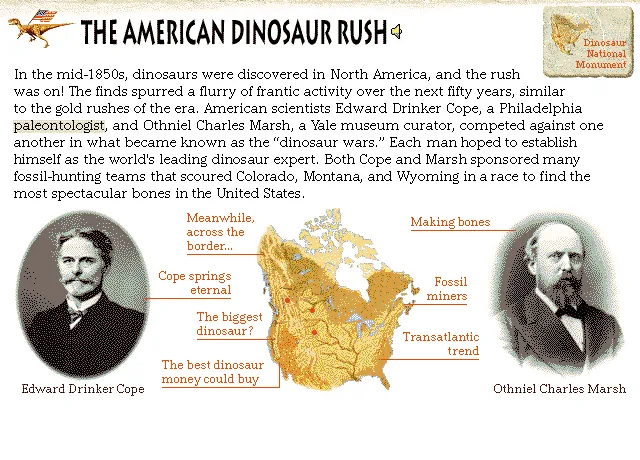
In the mid-1850s, dinosaurs were discovered in North America, and the rush was on! The finds spurred a flurry of frantic activity over the next fifty years, similar to the gold rushes of the era. American scientists Edward Drinker Cope, a Philadelphia paleontologist, and Othniel Charles Marsh, a Yale museum curator, competed against one another in what became known as the "dinosaur wars." Each man hoped to establish himself as the world's leading dinosaur expert. Both Cope and Marsh sponsored many fossil-hunting teams that scoured Colorado, Montana, and Wyoming in a race to find the most spectacular bones in the United States.

Explore

Transatlantic Trend

Transatlantic Trend

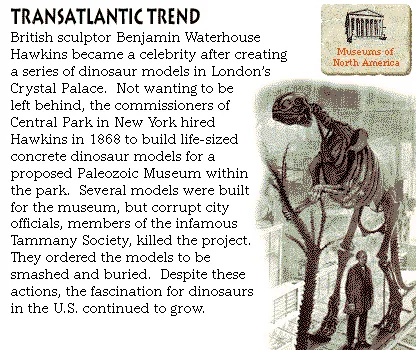
British sculptor Benjamin Waterhouse Hawkins became a celebrity after creating a series of dinosaur models in London's Crystal Palace. Not wanting to be left behind, the commissioners of Central Park in New York hired Hawkins in 1868 to build life-sized concrete dinosaur models for a proposed Paleozoic Museum within the park. Several models were built for the museum, but corrupt city officials, members of the infamous Tammany Society, killed the project. They ordered the models to be smashed and buried. Despite these actions, the fascination for dinosaurs in the U.S. continued to grow.
Making Bones

Making Bones

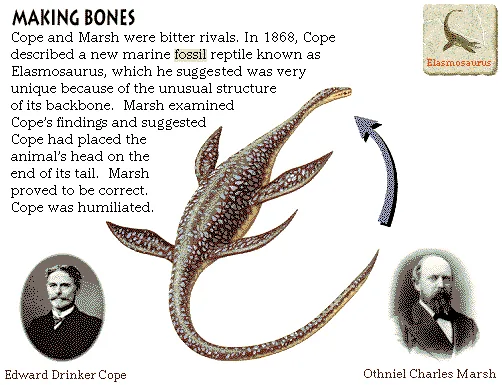
Cope and Marsh were bitter rivals. In 1868, Cope described a new marine fossil reptile known as Elasmosaurus, which he suggested was very unique because of the unusual structure of its backbone. Marsh examined Cope's findings and suggested Cope had placed the animal's head on the end of its tail. Marsh proved to be correct. Cope was humiliated.

Fossil Miners

Fossil Miners

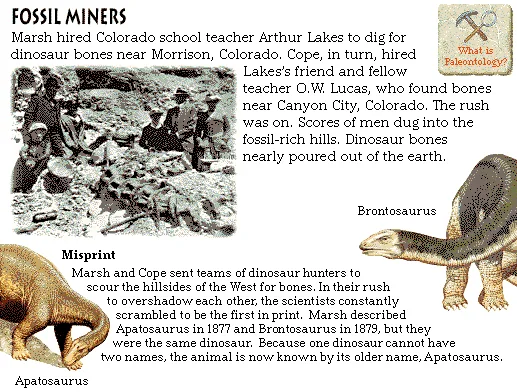
Marsh hired Colorado school teacher Arthur Lakes to dig for dinosaur bones near Morrison, Colorado. Cope, in turn, hired Lakes's friend and fellow teacher O.W. Lucas, who found bones near Canyon City, Colorado. The rush was on. Scores of men dug into the fossil-rich hills. Dinosaur bones nearly poured out of the earth.

MisprintMarsh and Cope sent teams of dinosaur hunters to scour the hillsides of the West for bones. In their rush to overshadow each other, the scientists constantly scrambled to be the first in print. Marsh described Apatosaurus in 1877 and Brontosaurus in 1879, but they were the same dinosaur. Because one dinosaur cannot have two names, the animal is now known by its older name, Apatosaurus.
Cope Springs Eternal

Cope Springs Eternal

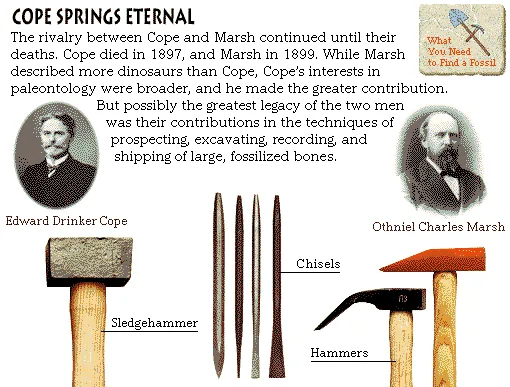
The rivalry between Cope and Marsh continued until their deaths. Cope died in 1897, and Marsh in 1899. While Marsh described more dinosaurs than Cope, Cope's interests in paleontology were broader, and he made the greater contribution. But possibly the greatest legacy of the two men was their contributions in the techniques of prospecting, excavating, recording, and shipping of large, fossilized bones.

The Best Dinosaur Money Could Buy

The Best Dinosaur Money Could Buy

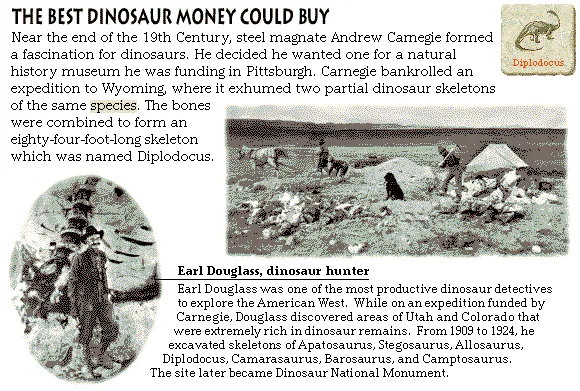
Near the end of the 19th Century, steel magnate Andrew Carnegie formed a fascination for dinosaurs. He decided he wanted one for a natural history museum he was funding in Pittsburgh. Carnegie bankrolled an expedition to Wyoming, where it exhumed two partial dinosaur skeletons of the same species. The bones were combined to form an eighty-four-foot-long skeleton which was named Diplodocus.

Earl Douglass, dinosaur hunterEarl Douglass was one of the most productive dinosaur detectives to explore the American West. While on an expedition funded by Carnegie, Douglass discovered areas of Utah and Colorado that were extremely rich in dinosaur remains. From 1909 to 1924, he excavated skeletons of Apatosaurus, Stegosaurus, Allosaurus, Diplodocus, Camarasaurus, Barosaurus, and Camptosaurus. The site later became Dinosaur National Monument.
The Biggest Dinosaur?

The Biggest Dinosaur?

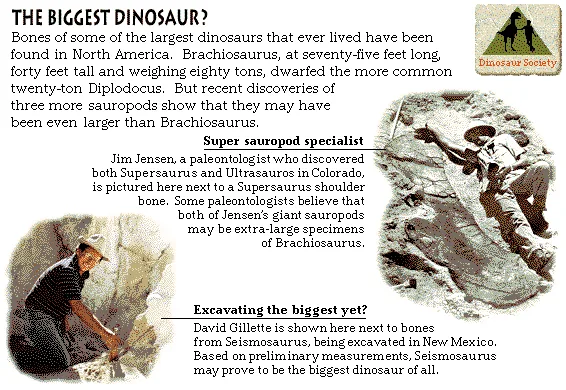
Bones of some of the largest dinosaurs that ever lived have been found in North America. Brachiosaurus, at seventy-five feet long, forty feet tall and weighing eighty tons, dwarfed the more common twenty-ton Diplodocus. But recent discoveries of three more sauropods show that they may have been even larger than Brachiosaurus.

Super sauropod specialistJim Jensen, a paleontologist who discovered both Supersaurus and Ultrasauros in Colorado, is pictured here next to a Supersaurus shoulder bone. Some paleontologists believe that both of Jensen's giant sauropods may be extra-large specimens of Brachiosaurus.
Excavating the biggest yet?David Gillette is shown here next to bones from Seismosaurus, being excavated in New Mexico. Based on preliminary measurements, Seismosaurus may prove to be the biggest dinosaur of all.
Meanwhile, Across the Border...

Meanwhile, Across the Border...

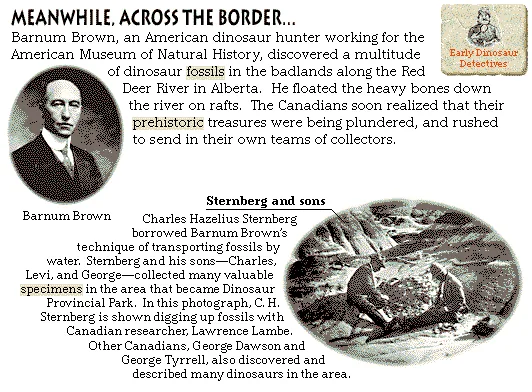
Barnum Brown, an American dinosaur hunter working for the American Museum of Natural History, discovered a multitude of dinosaur fossils in the badlands along the Red Deer River in Alberta. He floated the heavy bones down the river on rafts. The Canadians soon realized that their prehistoric treasures were being plundered, and rushed to send in their own teams of collectors.

Sternberg and sonsCharles Hazelius Sternberg borrowed Barnum Brown's technique of transporting fossils by water. Sternberg and his sons—Charles, Levi, and George—collected many valuable specimens in the area that became Dinosaur Provincial Park. In this photograph, C. H. Sternberg is shown digging up fossils with Canadian researcher, Lawrence Lambe. Other Canadians, George Dawson and George Tyrrell, also discovered and described many dinosaurs in the area.

Explore more

Source: Microsoft Dinosaurs (1993) CD-ROM. Text liberated from original screen art; images & audio restored from disc. Original media is Microsoft/supplier copyright — non-commercial educational preservation. Credits & Acknowledgements