Microsoft Dinosaurs
Tyrannosaurus Rex
Tyrannosaurus Rex
Tyrannosaurus rex

tie-RAN-oh-SOR-us rex name means “tyrant lizard king”

Seven-inch teeth, a skull five feet long, and an appetite to match — meet the tyrant lizard king.

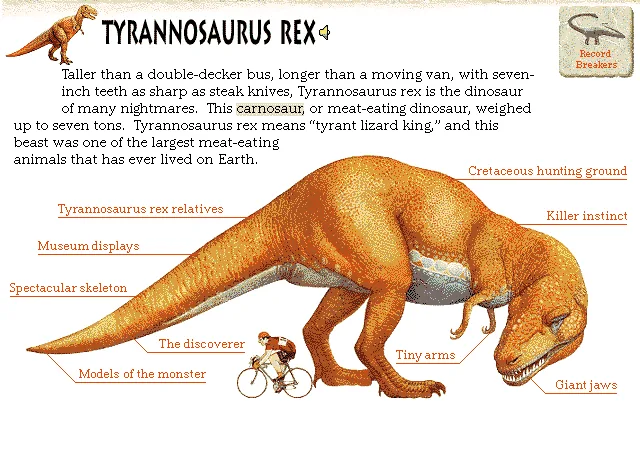
Taller than a double-decker bus, longer than a moving van, with seven-inch teeth as sharp as steak knives, Tyrannosaurus rex is the dinosaur of many nightmares. This carnosaur, or meat-eating dinosaur, weighed up to seven tons. Tyrannosaurus rex means "tyrant lizard king," and this beast was one of the largest meat-eating animals that has ever lived on Earth.

Explore

The Discoverer

The Discoverer

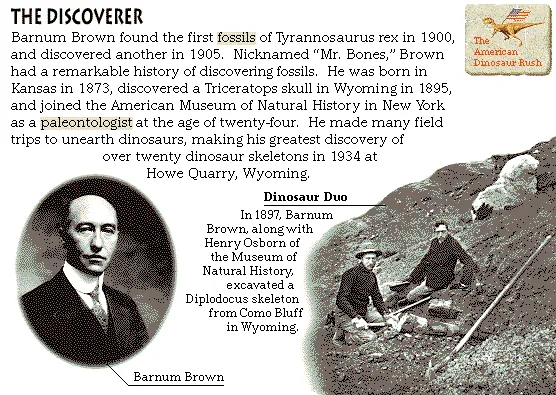
Barnum Brown found the first fossils of Tyrannosaurus rex in 1900, and discovered another in 1905. Nicknamed "Mr. Bones," Brown had a remarkable history of discovering fossils. He was born in Kansas in 1873, discovered a Triceratops skull in Wyoming in 1895, and joined the American Museum of Natural History in New York as a paleontologist at the age of twenty-four. He made many field trips to unearth dinosaurs, making his greatest discovery of over twenty dinosaur skeletons in 1934 at Howe Quarry, Wyoming.

Dinosaur DuoIn 1897, Barnum Brown, along with Henry Osborn of the Museum of Natural History, excavated a Diplodocus skeleton from Como Bluff in Wyoming.
Models of the Monster

Models of the Monster

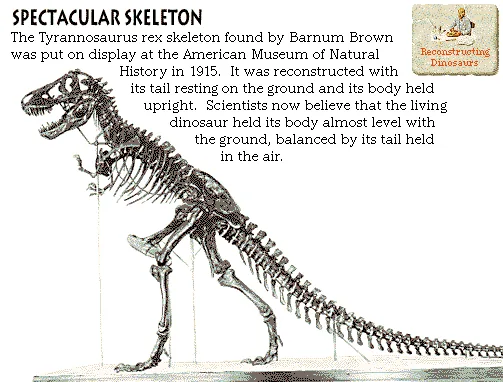
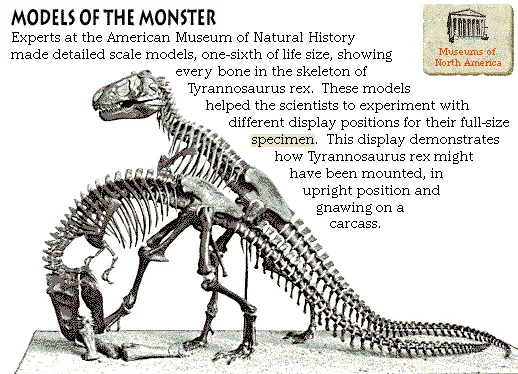
Experts at the American Museum of Natural History made detailed scale models, one-sixth of life size, showing every bone in the skeleton of Tyrannosaurus rex. These models helped the scientists to experiment with different display positions for their full-size specimen. This display demonstrates how Tyrannosaurus rex might have been mounted, in upright position and gnawing on a carcass.

Spectacular Skeleton

Spectacular Skeleton

The Tyrannosaurus rex skeleton found by Barnum Brown was put on display at the American Museum of Natural History in 1915. It was reconstructed with its tail resting on the ground and its body held upright. Scientists now believe that the living dinosaur held its body almost level with the ground, balanced by its tail held in the air.

Tiny Arms

Tiny Arms

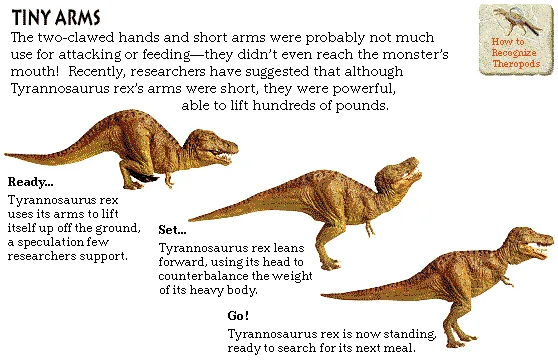
The two-clawed hands and short arms were probably not much use for attacking or feeding—they didn't even reach the monster's mouth! Recently, researchers have suggested that although Tyrannosaurus rex's arms were short, they were powerful, able to lift hundreds of pounds.

Ready...Tyrannosaurus rex uses its arms to lift itself up off the ground, a speculation few researchers support.
Set...Tyrannosaurus rex leans forward, using its head to counterbalance the weight of its heavy body.
Go!Tyrannosaurus rex is now standing, ready to search for its next meal.
Giant Jaws

Giant Jaws

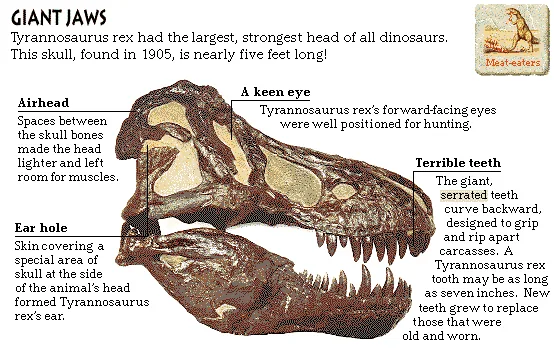
Tyrannosaurus rex had the largest, strongest head of all dinosaurs. This skull, found in 1905, is nearly five feet long!

AirheadSpaces between the skull bones made the head lighter and left room for muscles.
A keen eyeTyrannosaurus rex's forward-facing eyes were well positioned for hunting.
Ear holeSkin covering a special area of skull at the side of the animal's head formed Tyrannosaurus rex's ear.
Terrible teethThe giant, serrated teeth curve backward, designed to grip and rip apart carcasses. A Tyrannosaurus rex tooth may be as long as seven inches. New teeth grew to replace those that were old and worn.
Killer Instinct

Killer Instinct

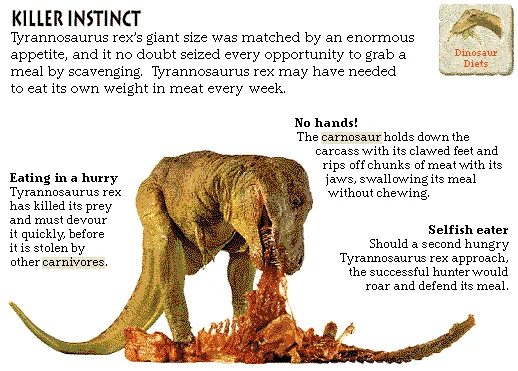
Tyrannosaurus rex's giant size was matched by an enormous appetite, and it no doubt seized every opportunity to grab a meal by scavenging. Tyrannosaurus rex may have needed to eat its own weight in meat every week.

Eating in a hurryTyrannosaurus rex has killed its prey and must devour it quickly, before it is stolen by other carnivores.
No hands!The carnosaur holds down the carcass with its clawed feet and rips off chunks of meat with its jaws, swallowing its meal without chewing.
Selfish eaterShould a second hungry Tyrannosaurus rex approach, the successful hunter would roar and defend its meal.
Cretaceous Hunting Ground

Cretaceous Hunting Ground

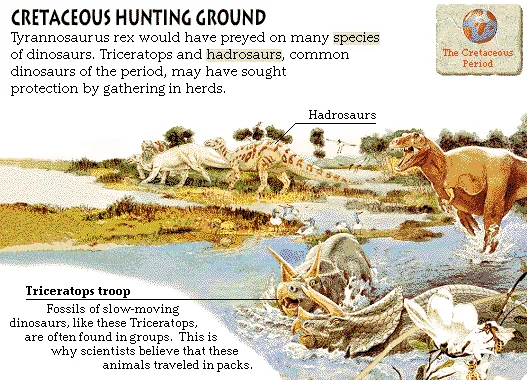
Tyrannosaurus rex would have preyed on many species of dinosaurs. Triceratops and hadrosaurs, common dinosaurs of the period, may have sought protection by gathering in herds.

Triceratops troopFossils of slow-moving dinosaurs, like these Triceratops, are often found in groups. This is why scientists believe that these animals traveled in packs.
Museum Displays

Museum Displays

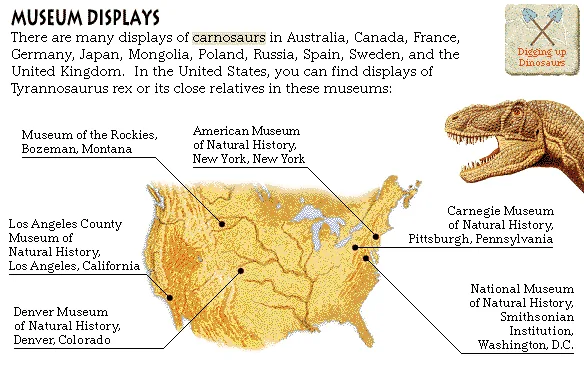
There are many displays of carnosaurs in Australia, Canada, France, Germany, Japan, Mongolia, Poland, Russia, Spain, Sweden, and the United Kingdom. In the United States, you can find displays of Tyrannosaurus rex or its close relatives in these museums:

Tyrannosaurus Rex Relatives

Tyrannosaurus Rex Relatives

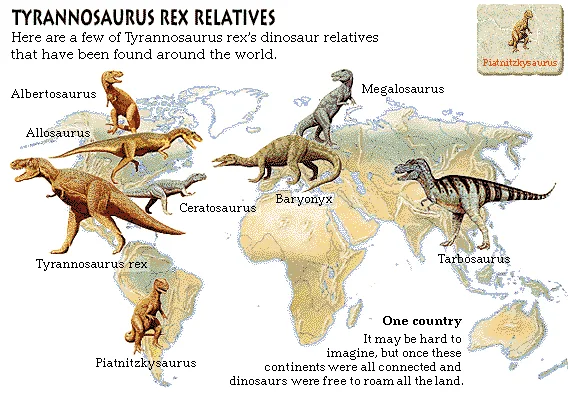
Here are a few of Tyrannosaurus rex's dinosaur relatives that have been found around the world.

One countryIt may be hard to imagine, but once these continents were all connected and dinosaurs were free to roam all the land.

Explore more

Source: Microsoft Dinosaurs (1993) CD-ROM. Text liberated from original screen art; images & audio restored from disc. Original media is Microsoft/supplier copyright — non-commercial educational preservation. Credits & Acknowledgements