Lumps and Bumps
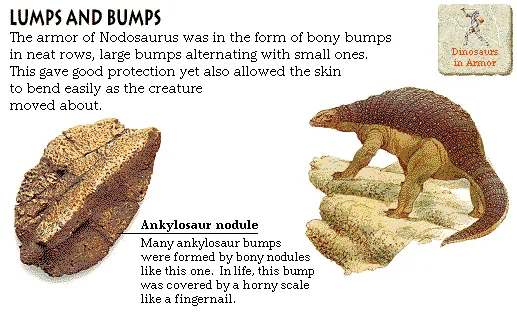
The armor of Nodosaurus was in the form of bony bumps in neat rows, large bumps alternating with small ones. This gave good protection yet also allowed the skin to bend easily as the creature moved about.
The lumpy lizard that wore bony armor from head to tail!
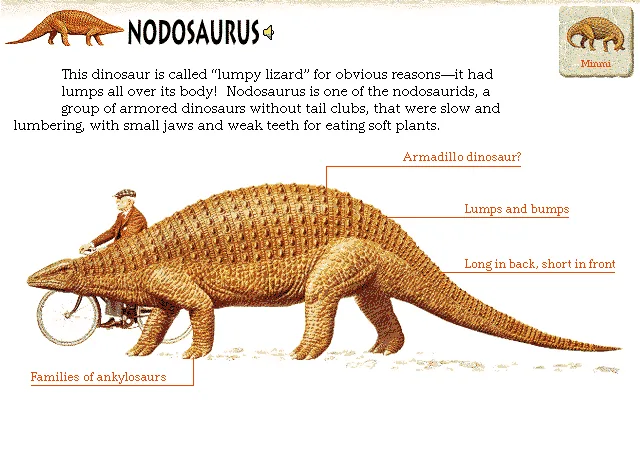
This dinosaur is called "lumpy lizard" for obvious reasons—it had lumps all over its body! Nodosaurus is one of the nodosaurids, a group of armored dinosaurs without tail clubs, that were slow and lumbering, with small jaws and weak teeth for eating soft plants.

The armor of Nodosaurus was in the form of bony bumps in neat rows, large bumps alternating with small ones. This gave good protection yet also allowed the skin to bend easily as the creature moved about.

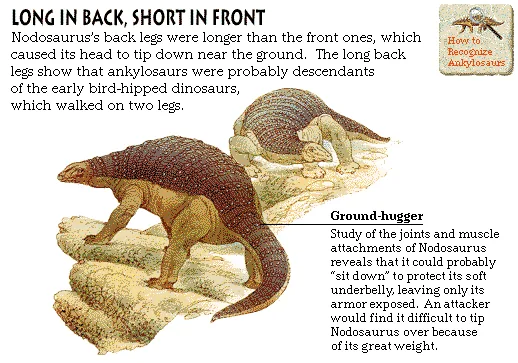
Nodosaurus's back legs were longer than the front ones, which caused its head to tip down near the ground. The long back legs show that ankylosaurs were probably descendants of the early bird-hipped dinosaurs, which walked on two legs.

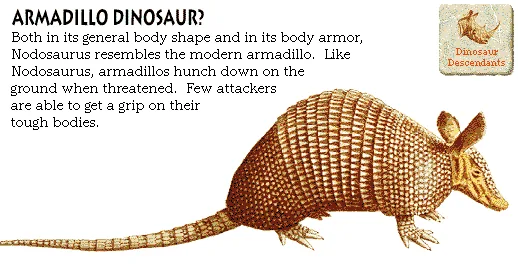
Both in its general body shape and in its body armor, Nodosaurus resembles the modern armadillo. Like Nodosaurus, armadillos hunch down on the ground when threatened. Few attackers are able to get a grip on their tough bodies.

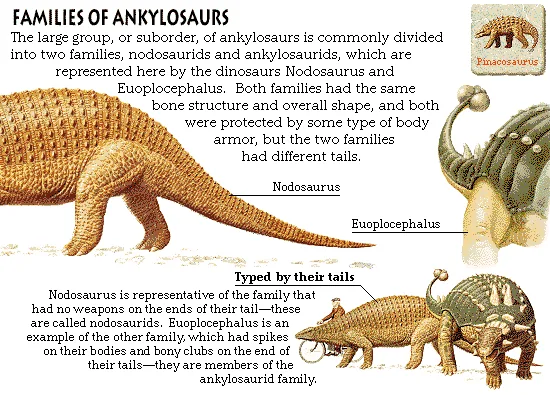
The large group, or suborder, of ankylosaurs is commonly divided into two families, nodosaurids and ankylosaurids, which are represented here by the dinosaurs Nodosaurus and Euoplocephalus. Both families had the same bone structure and overall shape, and both were protected by some type of body armor, but the two families had different tails.
Source: Microsoft Dinosaurs (1993) CD-ROM. Text liberated from original screen art; images & audio restored from disc. Original media is Microsoft/supplier copyright — non-commercial educational preservation. Credits & Acknowledgements