Microsoft Dinosaurs
The Triassic Period
The Triassic Period

try-ASS-ik

The dawn of the Age of Dinosaurs, when all of Earth was just one giant continent.

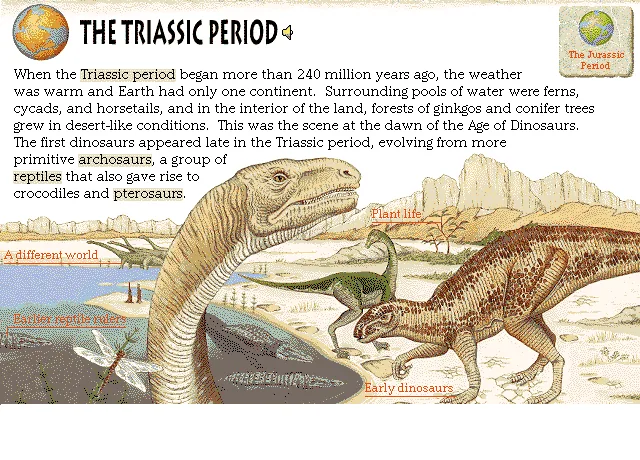
When the Triassic period began more than 240 million years ago, the weather was warm and Earth had only one continent. Surrounding pools of water were ferns, cycads, and horsetails, and in the interior of the land, forests of ginkgos and conifer trees grew in desert-like conditions. This was the scene at the dawn of the Age of Dinosaurs. The first dinosaurs appeared late in the Triassic period, evolving from more primitive archosaurs, a group of reptiles that also gave rise to crocodiles and pterosaurs.

Explore

A Different World

A Different World

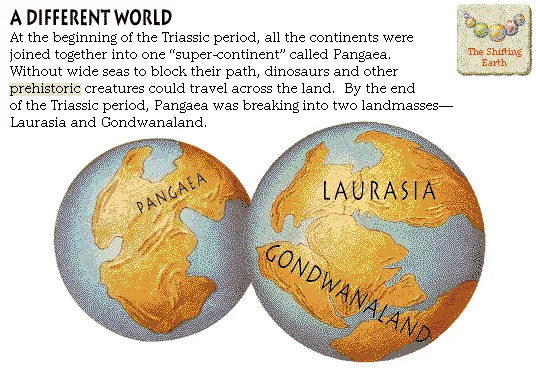
At the beginning of the Triassic period, all the continents were joined together into one "super-continent" called Pangaea. Without wide seas to block their path, dinosaurs and other prehistoric creatures could travel across the land. By the end of the Triassic period, Pangaea was breaking into two landmasses—Laurasia and Gondwanaland.

Earlier Reptile Rulers

Earlier Reptile Rulers

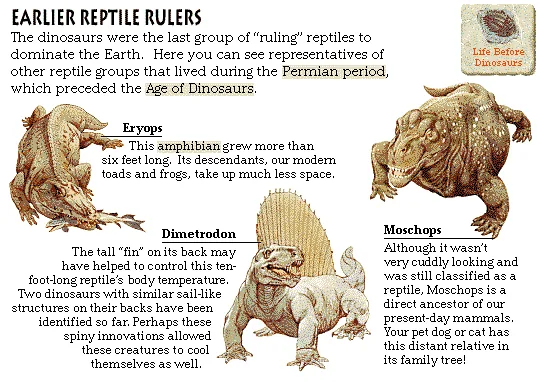
The dinosaurs were the last group of "ruling" reptiles to dominate the Earth. Here you can see representatives of other reptile groups that lived during the Permian period, which preceded the Age of Dinosaurs.

EryopsThis amphibian grew more than six feet long. Its descendants, our modern toads and frogs, take up much less space.
DimetrodonThe tall "fin" on its back may have helped to control this ten-foot-long reptile's body temperature. Two dinosaurs with similar sail-like structures on their backs have been identified so far. Perhaps these spiny innovations allowed these creatures to cool themselves as well.
MoschopsAlthough it wasn't very cuddly looking and was still classified as a reptile, Moschops is a direct ancestor of our present-day mammals. Your pet dog or cat has this distant relative in its family tree!
Plant Life

Plant Life

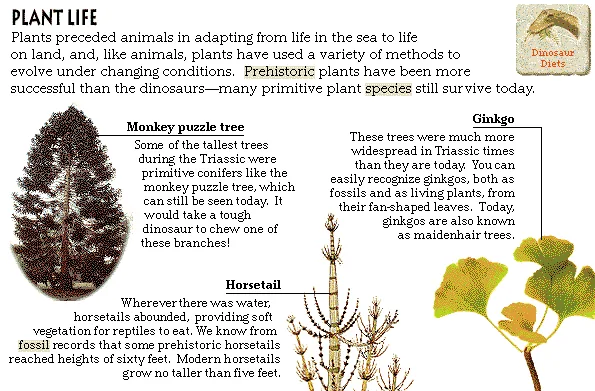
Plants preceded animals in adapting from life in the sea to life on land, and, like animals, plants have used a variety of methods to evolve under changing conditions. Prehistoric plants have been more successful than the dinosaurs—many primitive plant species still survive today.

Monkey puzzle treeSome of the tallest trees during the Triassic were primitive conifers like the monkey puzzle tree, which can still be seen today. It would take a tough dinosaur to chew one of these branches!
GinkgoThese trees were much more widespread in Triassic times than they are today. You can easily recognize ginkgos, both as fossils and as living plants, from their fan-shaped leaves. Today, ginkgos are also known as maidenhair trees.
HorsetailWherever there was water, horsetails abounded, providing soft vegetation for reptiles to eat. We know from fossil records that some prehistoric horsetails reached heights of sixty feet. Modern horsetails grow no taller than five feet.
Early Dinosaurs

Early Dinosaurs

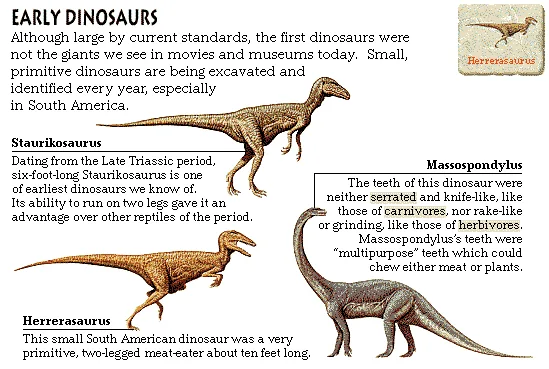
Although large by current standards, the first dinosaurs were not the giants we see in movies and museums today. Small, primitive dinosaurs are being excavated and identified every year, especially in South America.

StaurikosaurusDating from the Late Triassic period, six-foot-long Staurikosaurus is one of earliest dinosaurs we know of. Its ability to run on two legs gave it an advantage over other reptiles of the period.
HerrerasaurusThis small South American dinosaur was a very primitive, two-legged meat-eater about ten feet long.
MassospondylusThe teeth of this dinosaur were neither serrated and knife-like, like those of carnivores, nor rake-like or grinding, like those of herbivores. Massospondylus's teeth were "multipurpose" teeth which could chew either meat or plants.

Explore more

Source: Microsoft Dinosaurs (1993) CD-ROM. Text liberated from original screen art; images & audio restored from disc. Original media is Microsoft/supplier copyright — non-commercial educational preservation. Credits & Acknowledgements