Crowded Skies
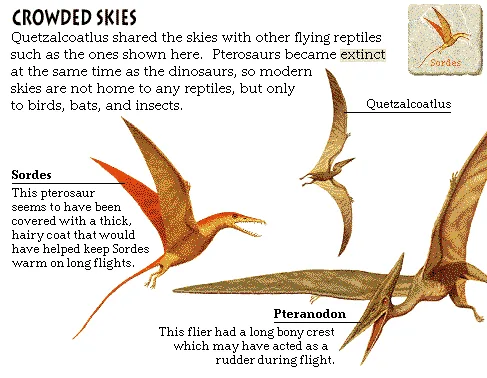
Quetzalcoatlus shared the skies with other flying reptiles such as the ones shown here. Pterosaurs became extinct at the same time as the dinosaurs, so modern skies are not home to any reptiles, but only to birds, bats, and insects.
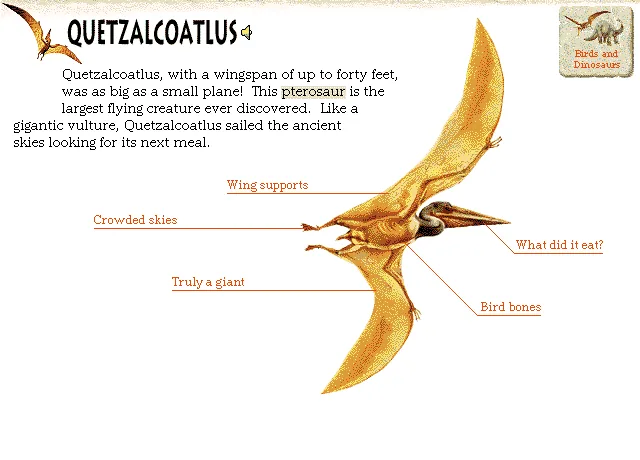
The largest flying creature ever discovered — with wings as wide as a small plane!
Quetzalcoatlus, with a wingspan of up to forty feet, was as big as a small plane! This pterosaur is the largest flying creature ever discovered. Like a gigantic vulture, Quetzalcoatlus sailed the ancient skies looking for its next meal.

Quetzalcoatlus shared the skies with other flying reptiles such as the ones shown here. Pterosaurs became extinct at the same time as the dinosaurs, so modern skies are not home to any reptiles, but only to birds, bats, and insects.

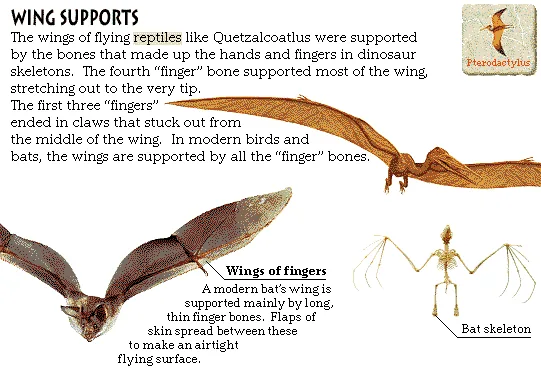
The wings of flying reptiles like Quetzalcoatlus were supported by the bones that made up the hands and fingers in dinosaur skeletons. The fourth "finger" bone supported most of the wing, stretching out to the very tip. The first three "fingers" ended in claws that stuck out from the middle of the wing. In modern birds and bats, the wings are supported by all the "finger" bones.

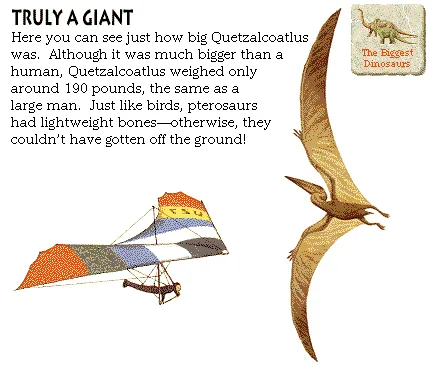
Here you can see just how big Quetzalcoatlus was. Although it was much bigger than a human, Quetzalcoatlus weighed only around 190 pounds, the same as a large man. Just like birds, pterosaurs had lightweight bones—otherwise, they couldn't have gotten off the ground!

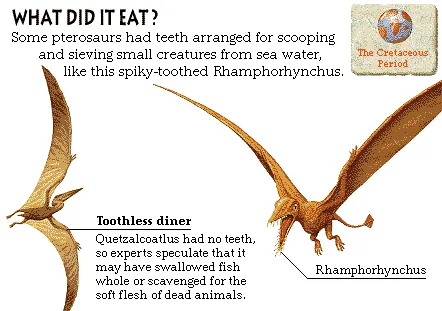
Some pterosaurs had teeth arranged for scooping and sieving small creatures from sea water, like this spiky-toothed Rhamphorhynchus.

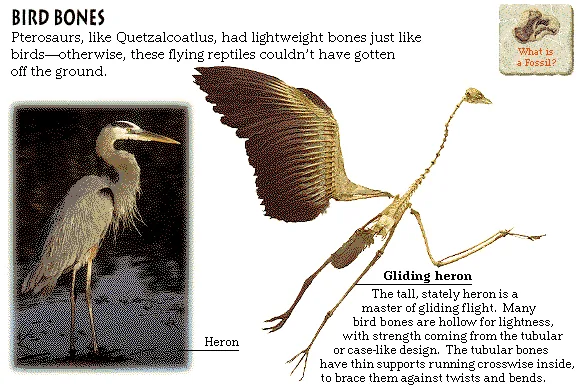
Pterosaurs, like Quetzalcoatlus, had lightweight bones just like birds—otherwise, these flying reptiles couldn't have gotten off the ground.
Source: Microsoft Dinosaurs (1993) CD-ROM. Text liberated from original screen art; images & audio restored from disc. Original media is Microsoft/supplier copyright — non-commercial educational preservation. Credits & Acknowledgements