Microsoft Dinosaurs
Euoplocephalus
Euoplocephalus
Euoplocephalus

yoo-OP-loh-SEF-uh-lus name means β€œWell armored head”

This dinosaur wore a finer suit of armor than any medieval knight β€” even its eyelids were armor-plated!

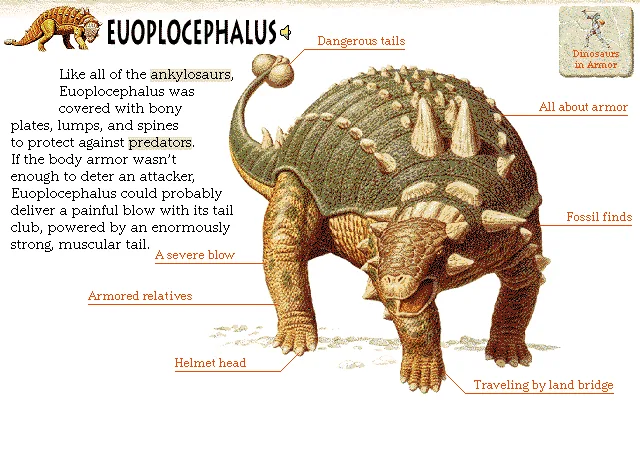
Like all of the ankylosaurs, Euoplocephalus was covered with bony plates, lumps, and spines to protect against predators. If the body armor wasn't enough to deter an attacker, Euoplocephalus could probably deliver a painful blow with its tail club, powered by an enormously strong, muscular tail.

Explore

Dangerous Tails

Dangerous Tails

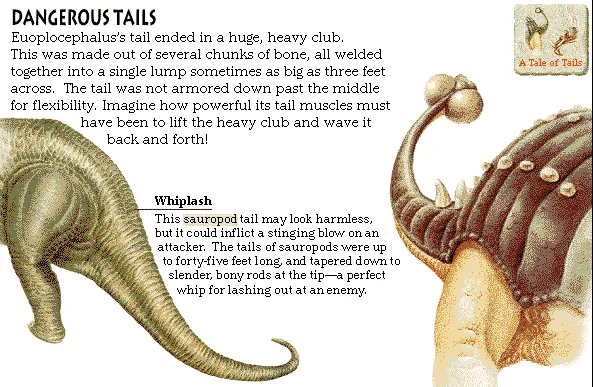
Euoplocephalus's tail ended in a huge, heavy club. This was made out of several chunks of bone, all welded together into a single lump sometimes as big as three feet across. The tail was not armored down past the middle for flexibility. Imagine how powerful its tail muscles must have been to lift the heavy club and wave it back and forth!

WhiplashThis sauropod tail may look harmless, but it could inflict a stinging blow on an attacker. The tails of sauropods were up to forty-five feet long, and tapered down to slender, bony rods at the tipβ€”a perfect whip for lashing out at an enemy.
All About Armor

All About Armor

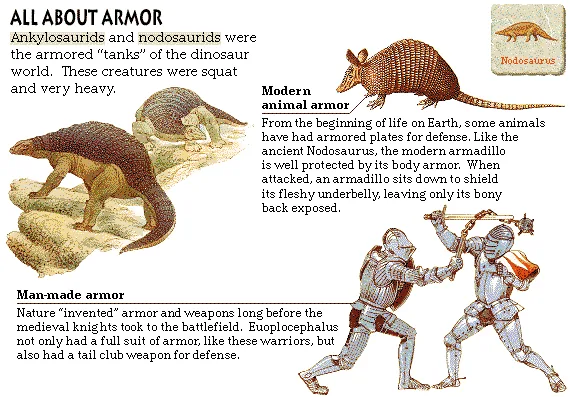
Ankylosaurids and nodosaurids were the armored "tanks" of the dinosaur world. These creatures were squat and very heavy.

Modern animal armorFrom the beginning of life on Earth, some animals have had armored plates for defense. Like the ancient Nodosaurus, the modern armadillo is well protected by its body armor. When attacked, an armadillo sits down to shield its fleshy underbelly, leaving only its bony back exposed.
Man-made armorNature "invented" armor and weapons long before the medieval knights took to the battlefield. Euoplocephalus not only had a full suit of armor, like these warriors, but also had a tail club weapon for defense.
Traveling by Land Bridge

Traveling by Land Bridge

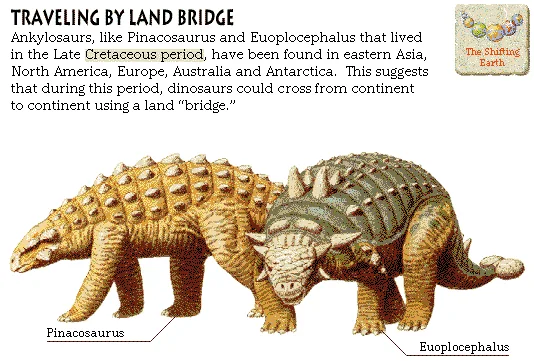
Ankylosaurs, like Pinacosaurus and Euoplocephalus that lived in the Late Cretaceous period, have been found in eastern Asia, North America, Europe, Australia and Antarctica. This suggests that during this period, dinosaurs could cross from continent to continent using a land "bridge."

A Severe Blow

A Severe Blow

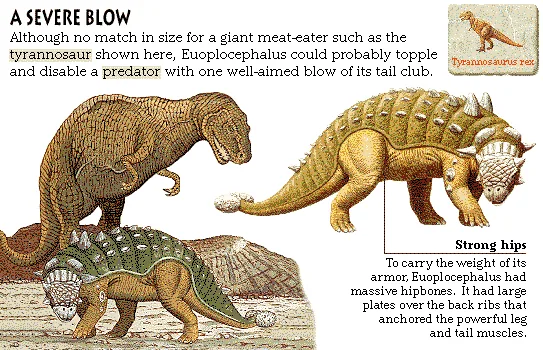
Although no match in size for a giant meat-eater such as the tyrannosaur shown here, Euoplocephalus could probably topple and disable a predator with one well-aimed blow of its tail club.

Strong hipsTo carry the weight of its armor, Euoplocephalus had massive hipbones. It had large plates over the back ribs that anchored the powerful leg and tail muscles.
Armored Relatives

Armored Relatives

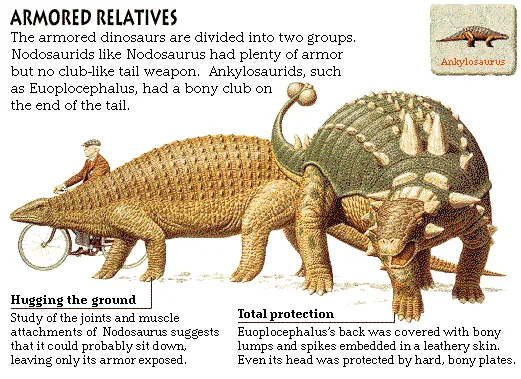
The armored dinosaurs are divided into two groups. Nodosaurids like Nodosaurus had plenty of armor but no club-like tail weapon. Ankylosaurids, such as Euoplocephalus, had a bony club on the end of the tail.

Hugging the groundStudy of the joints and muscle attachments of Nodosaurus suggests that it could probably sit down, leaving only its armor exposed.
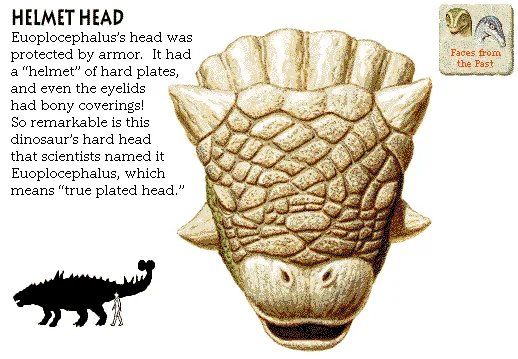
Total protectionEuoplocephalus's back was covered with bony lumps and spikes embedded in a leathery skin. Even its head was protected by hard, bony plates.
Fossil Finds

Fossil Finds

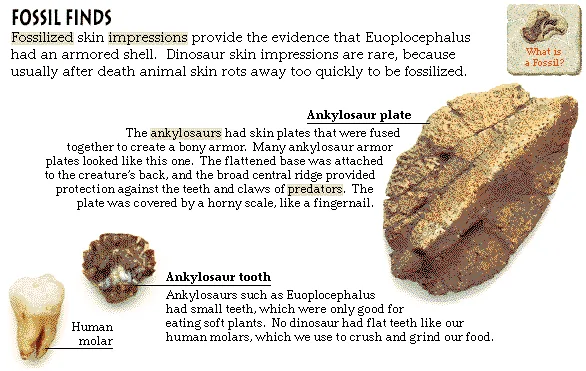
Fossilized skin impressions provide the evidence that Euoplocephalus had an armored shell. Dinosaur skin impressions are rare, because usually after death animal skin rots away too quickly to be fossilized.

Ankylosaur plateThe ankylosaurs had skin plates that were fused together to create a bony armor. Many ankylosaur armor plates looked like this one. The flattened base was attached to the creature's back, and the broad central ridge provided protection against the teeth and claws of predators. The plate was covered by a horny scale, like a fingernail.
Ankylosaur toothAnkylosaurs such as Euoplocephalus had small teeth, which were only good for eating soft plants. No dinosaur had flat teeth like our human molars, which we use to crush and grind our food.
Helmet Head

Helmet Head

Euoplocephalus's head was protected by armor. It had a "helmet" of hard plates, and even the eyelids had bony coverings! So remarkable is this dinosaur's hard head that scientists named it Euoplocephalus, which means "true plated head."

Explore more

Source: Microsoft Dinosaurs (1993) CD-ROM. Text liberated from original screen art; images & audio restored from disc. Original media is Microsoft/supplier copyright β€” non-commercial educational preservation. Credits & Acknowledgements