Microsoft Dinosaurs
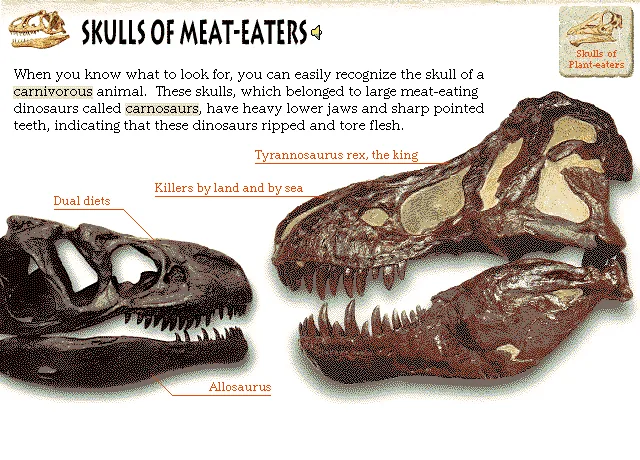
Skulls of Meat-Eaters

Heavy jaws, serrated teeth, and bone-crushing power — the skulls of carnosaurs reveal deadly predators.

When you know what to look for, you can easily recognize the skull of a carnivorous animal. These skulls, which belonged to large meat-eating dinosaurs called carnosaurs, have heavy lower jaws and sharp pointed teeth, indicating that these dinosaurs ripped and tore flesh.

Explore

Tyrannosaurus Rex, the King

Tyrannosaurus Rex, the King

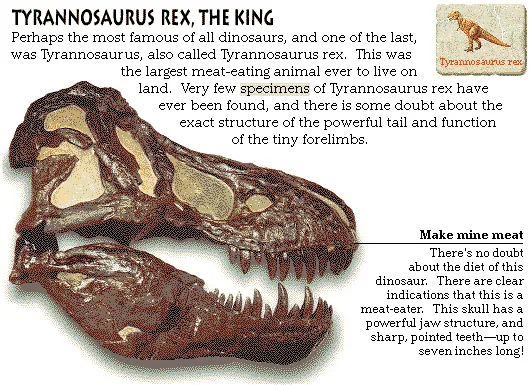
Perhaps the most famous of all dinosaurs, and one of the last, was Tyrannosaurus, also called Tyrannosaurus rex. This was the largest meat-eating animal ever to live on land. Very few specimens of Tyrannosaurus rex have ever been found, and there is some doubt about the exact structure of the powerful tail and function of the tiny forelimbs.

Make mine meatThere's no doubt about the diet of this dinosaur. There are clear indications that this is a meat-eater. This skull has a powerful jaw structure, and sharp, pointed teeth—up to seven inches long!
Allosaurus

Allosaurus

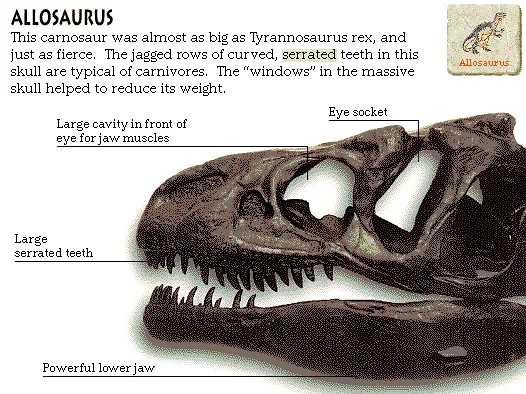
This carnosaur was almost as big as Tyrannosaurus rex, and just as fierce. The jagged rows of curved, serrated teeth in this skull are typical of carnivores. The "windows" in the massive skull helped to reduce its weight.

Large cavity in front of eye for jaw musclesLarge cavity in front of eye for jaw muscles
Eye socketEye socket
Large serrated teethLarge serrated teeth
Powerful lower jawPowerful lower jaw
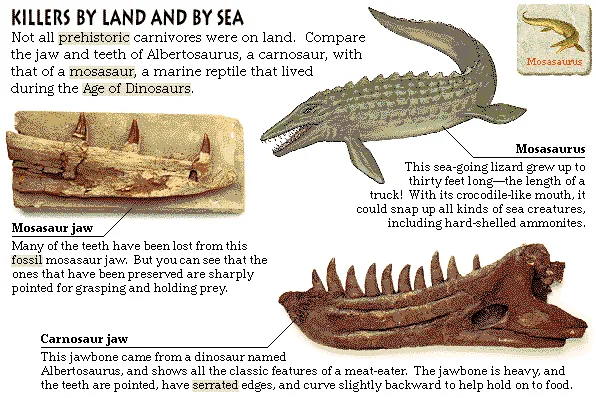
Killers by Land and by Sea

Killers by Land and by Sea

Not all prehistoric carnivores were on land. Compare the jaw and teeth of Albertosaurus, a carnosaur, with that of a mosasaur, a marine reptile that lived during the Age of Dinosaurs.

Mosasaur jawMany of the teeth have been lost from this fossil mosasaur jaw. But you can see that the ones that have been preserved are sharply pointed for grasping and holding prey.
MosasaurusThis sea-going lizard grew up to thirty feet long—the length of a truck! With its crocodile-like mouth, it could snap up all kinds of sea creatures, including hard-shelled ammonites.
Carnosaur jawThis jawbone came from a dinosaur named Albertosaurus, and shows all the classic features of a meat-eater. The jawbone is heavy, and the teeth are pointed, have serrated edges, and curve slightly backward to help hold on to food.
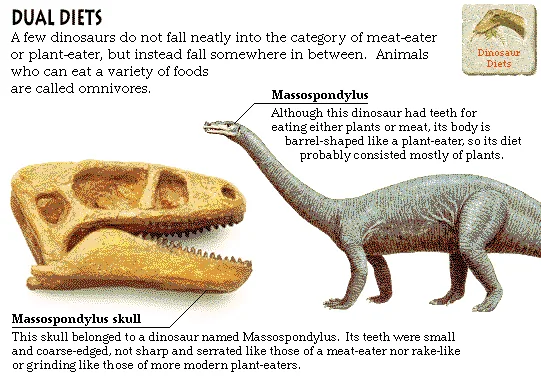
Dual Diets

Dual Diets

A few dinosaurs do not fall neatly into the category of meat-eater or plant-eater, but instead fall somewhere in between. Animals who can eat a variety of foods are called omnivores.

Massospondylus skullThis skull belonged to a dinosaur named Massospondylus. Its teeth were small and coarse-edged, not sharp and serrated like those of a meat-eater nor rake-like or grinding like those of more modern plant-eaters.
MassospondylusAlthough this dinosaur had teeth for eating either plants or meat, its body is barrel-shaped like a plant-eater, so its diet probably consisted mostly of plants.

Explore more

Source: Microsoft Dinosaurs (1993) CD-ROM. Text liberated from original screen art; images & audio restored from disc. Original media is Microsoft/supplier copyright — non-commercial educational preservation. Credits & Acknowledgements